Malaysia: Real Estate and Investment Opportunities (2026 Outlook)
Malaysia has quietly become one of Southeast Asia's most accessible property markets for foreign capital.

Why Malaysia, Why Now
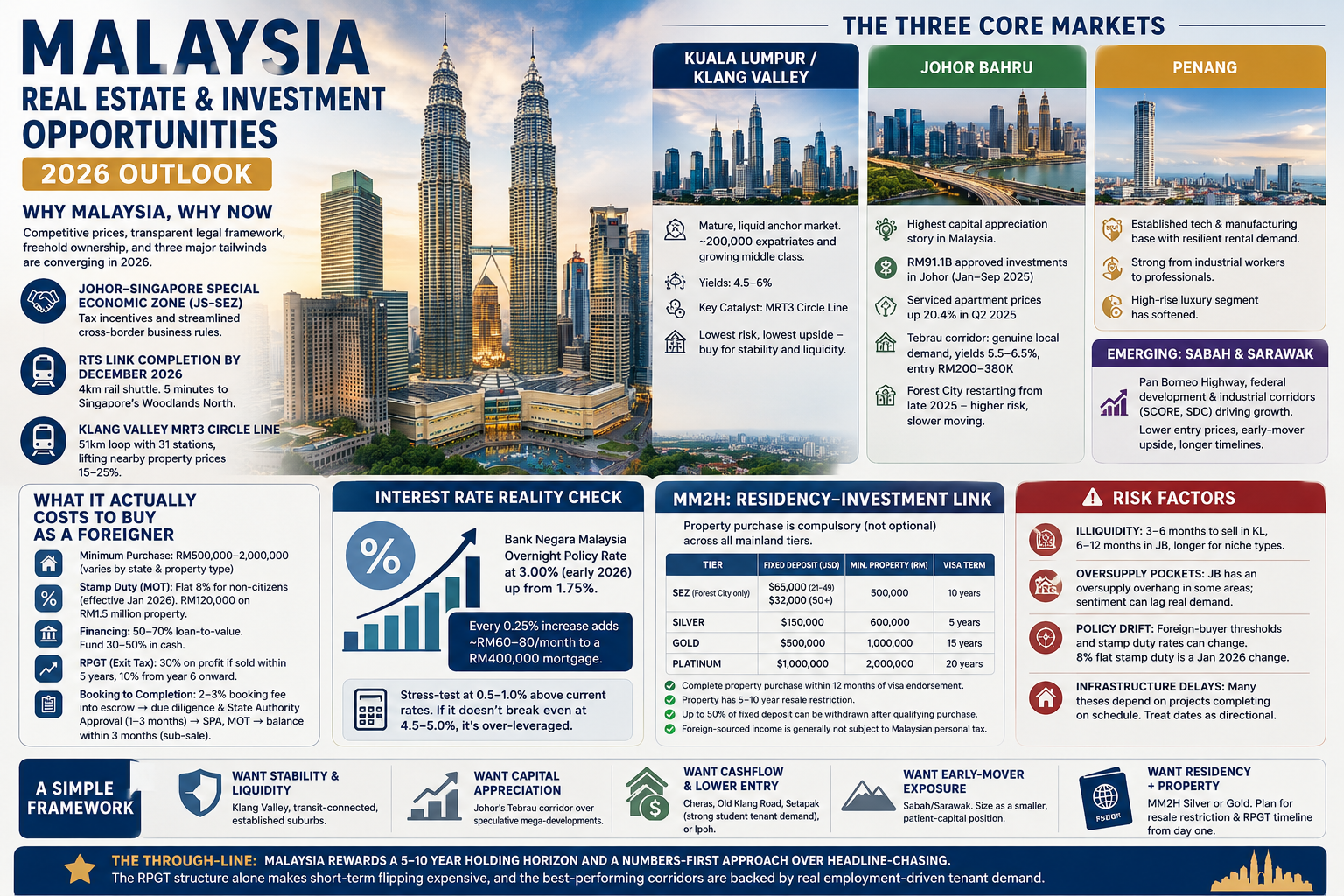
Malaysia has quietly become one of Southeast Asia's most accessible property markets for foreign capital. Prices remain competitive against regional peers like Singapore, Bangkok, and even parts of Vietnam, while the legal framework for foreign ownership is transparent and well-established — freehold titles are available, property rights are enforceable, and the purchase process runs through licensed solicitors and a regulated escrow system.
Three structural tailwinds are converging in 2026:
- The Johor–Singapore Special Economic Zone (JS-SEZ), announced in January 2026, is opening tax incentives and streamlined cross-border business rules in Johor.
- The RTS Link, a 4km rail shuttle connecting Johor Bahru to Singapore's Woodlands North in five minutes, is expected to complete by December 2026 — effectively making JB a commuter suburb of Singapore.
- Klang Valley's MRT3 Circle Line, a 51km loop with 31 stations, is reshaping property values along its corridor, with stations reportedly lifting nearby prices 15–25%.
The Three Core Markets
Kuala Lumpur / Klang Valley — The mature, liquid anchor market. Rental demand is driven by roughly 200,000 expatriates and a growing local middle class. Yields run 4.5–6%, prices have stabilized after a post-Covid correction, and the MRT3 build-out is the key catalyst to watch. This is the lowest-risk, lowest-upside option — buy here for stability and liquidity, not for outsized capital gains.
Johor Bahru — The highest capital appreciation story in the country right now. Johor pulled in RM91.1 billion in approved investments in the first nine months of 2025 alone, the most of any state, largely tied to industrial and manufacturing growth. Serviced apartment prices in JB jumped 20.4% in Q2 2025 versus the 2024 average. Within Johor, the Tebrau corridor stands out for genuine local employment-driven demand (yields of 5.5–6.5%, entry prices of RM200–380K) as opposed to speculative, Singapore-commuter-dependent developments. Forest City — the RM/€700 billion artificial-island megaproject — is restarting post-Covid, with first residents moving in from late 2025, but it remains higher-risk and slower-moving than the surrounding Tebrau/JB city corridor.
Penang — The steady middle ground. An established technology and manufacturing base gives it resilient rental demand, particularly from industrial workers and professionals, though the high-rise luxury segment has softened.
Emerging: Sabah & Sarawak (East Malaysia) — The frontier play. Driven by the Pan Borneo Highway, large federal development budgets, and industrial corridors (SCORE, SDC), East Malaysia offers lower entry prices and early-mover upside, with the trade-off of longer timelines and less market maturity. Best suited to patient, long-horizon capital.
What It Actually Costs to Buy as a Foreigner
- Minimum purchase threshold: Varies by state, typically RM500,000–2,000,000, with some states applying different minimums by property type.
- Stamp duty (Memorandum of Transfer): A flat 8% for non-citizens, effective January 2026 — up from the tiered rates of previous years. On a RM1.5 million property, that's RM120,000 in stamp duty alone.
- Financing: Malaysian banks typically offer non-residents 50–70% loan-to-value, so expect to fund 30–50% in cash.
- RPGT (Real Property Gains Tax / exit tax): 30% on profit if sold within the first five years, dropping to 10% from year six onward. This is the single biggest factor separating a genuine multi-year investment from a quick flip.
- Booking to completion: A 2–3% booking fee into escrow, followed by due diligence and State Authority Approval (1–3 months), then the Sale & Purchase Agreement, MOT, and — for sub-sale properties — the remaining balance due within three months of approval.
Interest Rate Reality Check
Bank Negara Malaysia has raised the Overnight Policy Rate from a pandemic-era low of 1.75% to 3.00% as of early 2026. Every 0.25% increase adds roughly RM60–80/month to a RM400,000 mortgage. The practical implication: stress-test any deal at 0.5–1.0% above current rates. If a property doesn't break even at a 4.5–5.0% mortgage rate, it's over-leveraged for this cycle.
MM2H: The Residency-Investment Link
Malaysia's My Second Home programme is now directly tied to property purchase — a relevant detail for anyone evaluating Malaysia as a residency base alongside a straight investment case. As of 2026 it runs on four tiers:
SEZ (Forest City only) — Fixed deposit of USD 65,000 (ages 21–49) or USD 32,000 (ages 50+), minimum property RM 500,000, 10-year visa term.
Silver — Fixed deposit of USD 150,000, minimum property RM 600,000, 5-year visa term.
Gold — Fixed deposit of USD 500,000, minimum property RM 1,000,000, 15-year visa term.
Platinum — Fixed deposit of USD 1,000,000, minimum property RM 2,000,000, 20-year visa term.
Key mechanics to know: property purchase is compulsory (not optional) across all mainland tiers, must generally be completed within 12 months of visa endorsement, and the property carries a 5–10 year resale restriction. Up to 50% of the fixed deposit can be withdrawn after the qualifying property purchase. Foreign-sourced income is generally not subject to Malaysian personal tax for residents — a meaningful detail for anyone running income-generating ventures based outside Malaysia. The frugal-retiree version of this programme effectively no longer exists; the 2024 relaunch under MOTAC was a deliberate shift toward higher-net-worth applicants.
Risk Factors Worth Sitting With
- Illiquidity: Average time-to-sell is 3–6 months for a KL condo, 6–12 months in JB, and longer for niche property types. This is not a market for capital you may need within 3–5 years.
- Oversupply pockets: JB's broader narrative still carries an oversupply overhang from the Iskandar-era mega-developments; sentiment can lag genuine demand improvements in specific corridors.
- Policy drift: State-level foreign-buyer thresholds and stamp duty rates have moved before and can move again — the 8% flat stamp duty itself is a January 2026 change.
- Infrastructure timelines slip: East Malaysia's thesis and much of Johor's thesis depend on infrastructure completing on schedule; treat published completion dates as directional, not guaranteed.
A Simple Framework
- Want stability and liquidity: Klang Valley, transit-connected, established suburb.
- Want capital appreciation and are comfortable with more risk: Johor's Tebrau corridor over speculative mega-developments; watch the RTS Link completion as the key trigger event.
- Want cashflow yield with lower entry cost: Cheras, Old Klang Road, Setapak (strong recession-resistant student tenant demand), or Ipoh.
- Want early-mover long-horizon exposure: Sabah/Sarawak, sized as a smaller, patient-capital position.
- Want residency + property in one structure: MM2H Silver or Gold, sized to the property minimum for your target state, with the resale restriction and RPGT timeline built into your hold-period planning from day one.
The through-line across all of this: Malaysia rewards a 5–10 year holding horizon and a numbers-first approach over headline-chasing. The RPGT structure alone makes short-term flipping expensive, and the best-performing corridors right now are the ones with real employment-driven tenant demand rather than speculative or purely lifestyle-driven pricing.