Inside the JUPARS Infiniverse: 36 Questions About the Vision, the Worlds and the Work Ahead
JUPARS Infiniverse is a growing ecosystem of writing, music, stories, spirituality, learning, culture, enterprise and imagination. This conversation explains some of what JUPARS is, some of what it may become and, perhaps wisely, leaves a few doors unopened.
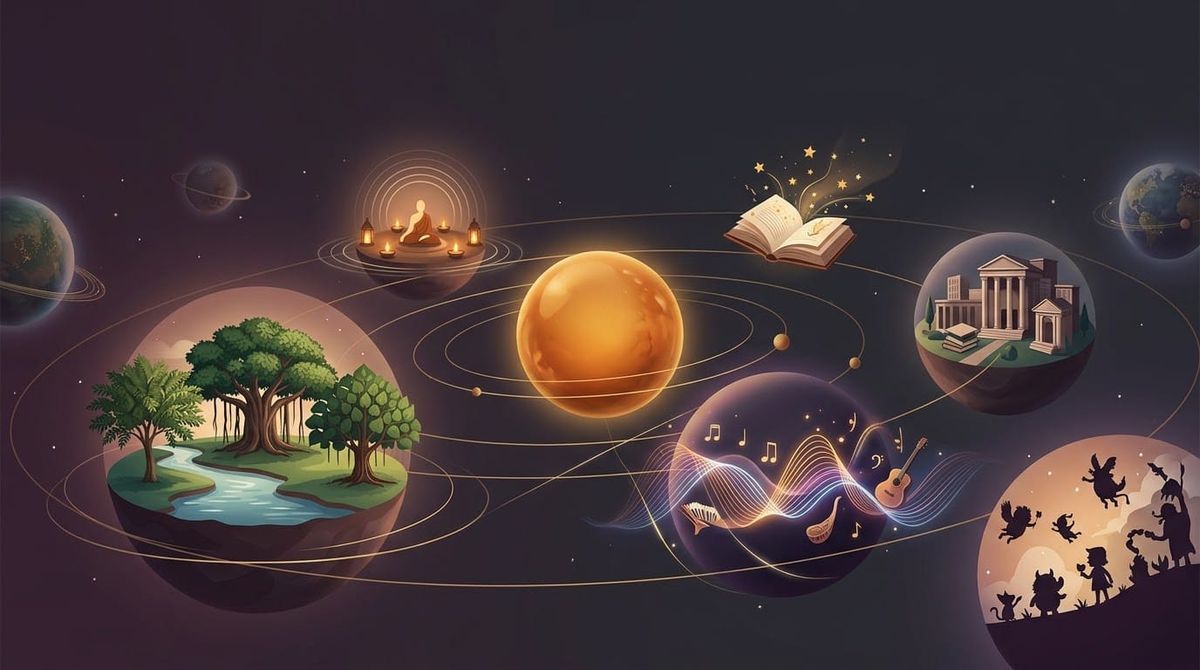
JUPARS Infiniverse is a growing ecosystem of writing, music, stories, spirituality, learning, culture, enterprise and imagination.
Its public archive began on 6 December 2025. Since then, hundreds of written pieces, original tracks, videos, characters, channels and creative experiments have emerged across its interconnected worlds.
The ecosystem is visible. Its architect remains intentionally understated.
This conversation explains some of what JUPARS is, some of what it may become and, perhaps wisely, leaves a few doors unopened.
The First Encounter
1. If someone discovers JUPARS today, how would you explain it in one minute?
JUPARS Infiniverse is a connected ecosystem containing many independent creative and professional worlds.
One part may publish essays. Another may create music or chanting experiences. Others may explore storytelling, culture, spirituality, humour, learning or enterprise.
Each world has its own identity, but they share one larger philosophy: imagination should not be restricted to a single category.
The simplest description may still be the best. One vision. Many worlds. Infinite possibilities.
2. Is JUPARS a company, a media network, a creative studio or something else?
At present, it contains elements of all three without fitting neatly into any one definition.
It creates and publishes media. It develops original intellectual properties. It explores business possibilities. It also preserves ideas that may not need immediate commercial outcomes.
Over time, different parts may develop their own organisational structures. The umbrella itself is better understood as an ecosystem than as one conventional company attempting to do everything.
3. Why use the word “Infiniverse”?
Because “universe” still sounded singular.
The underlying belief is that imagination is effectively infinite and that every meaningful idea deserves an appropriate home. Some ideas belong together. Others need their own atmosphere, audience, voice and rules.
“Infiniverse” allows these worlds to remain distinct without becoming disconnected.
It is less like one enormous building and more like a continent made up of very different islands.
4. Why not place everything under one large JUPARS channel?
Because a person searching for spiritual chanting may not be looking for a fictional bear, an enterprise discussion or a humorous essay five seconds later.
A single channel would make the output look random. Separate worlds allow people to choose their own entrance.
The umbrella remains important because it reveals the broader architecture. But the individual universes should be able to stand, develop and attract audiences in their own right.
5. The name sounds futuristic. Is JUPARS connected with Bitcoin, Ethereum or any cryptocurrency?
No.
JUPARS Infiniverse is not a cryptocurrency, token, blockchain investment or financial scheme.
Occasionally, coins may appear as symbolic objects, artwork or collectibles within the creative ecosystem. They are not cryptocurrency and should not be understood as investment products.
The futuristic language comes from world building and imagination, not from crypto branding.
Origins and Identity
6. Did JUPARS begin with a carefully prepared master plan?
No. The architecture came later.
JUPARS began during a difficult period with a much simpler decision: continue creating.
Writing, music, professional ideas, languages and imaginary worlds began developing beside one another. Eventually, it became clear that these were not unrelated distractions. They were parts of a larger system that had not yet been named.
In that sense, JUPARS was discovered while it was being built.
7. Was there one original creation that started everything?
There was no single dramatic launch moment.
Writing became an early connective force. Music expanded the emotional range. Professional experience found expression through GRIP. Spiritual exploration developed through Chantism and its connected music worlds. Characters and fictional environments then began demanding spaces of their own.
The first true creation was probably not a song or essay. It was the decision not to stop.
8. Why has the person behind JUPARS remained unnamed?
Because the work should be encountered before the biography.
An identity can sometimes become a shortcut. People begin evaluating ideas through nationality, profession, age, appearance, status or personal history before engaging with the ideas themselves.
Anonymity also protects creative freedom. Different worlds can develop without every character or statement being treated as autobiography.
The ecosystem is public. The architect does not need to occupy its centre.
9. Is the anonymity meant to manufacture mystery?
No, although curiosity is a natural consequence.
There is no complicated identity game being played. Information is simply being released according to relevance rather than curiosity.
The intention is not to hide forever or to create endless speculation. It is to prevent the creator from becoming more important than the creation during this formative stage.
Some questions become less interesting once answered. There is no urgency to answer all of them.
10. How personal is the philosophy behind JUPARS?
Very personal, but not always biographical.
The emphasis on resilience, continuation, imagination and refusing narrow labels comes from lived experience. However, JUPARS is not a disguised diary.
Personal truth may become an essay, a fictional scene, a character, a chant, a joke or an entirely new universe. The emotion can be real even when the form is imaginary.
Architecture of the Infiniverse
11. What qualifies an idea to become its own universe?
It must have more than novelty.
A universe needs a distinct purpose, voice, atmosphere and capacity for continued growth. It should be able to produce multiple expressions such as stories, songs, conversations, characters, research, products or experiences.
Many ideas remain individual pieces. Some are absorbed into existing worlds. A few begin producing their own gravity.
When an idea starts attracting related ideas around itself, it may be becoming a universe.
12. How do you keep so many worlds connected?
They are connected through principles rather than appearances.
A spiritual channel and a fictional comedy world may not look related, but both can reflect curiosity, dignity, hope, humour and openness.
There is also an internal architecture moving from the JUPARS umbrella to broad domains, individual universes, recurring series and characters.
The purpose of the system is not to make everything look identical. It is to let everything remain recognisably related.
13. Who decides when an idea should be developed, merged or abandoned?
For now, those decisions remain close to the original creative centre, but they are increasingly supported by structure, documentation and audience response.
An idea is not continued merely because it received immediate attention. Some concepts need time. Likewise, an idea is not protected forever simply because effort has already gone into it.
The test is whether it still possesses life, relevance and room to grow.
14. What happens to the ideas that do not work?
They are rarely considered wasted.
Some are archived. Some lend a name, character, visual language or sentence to another project. Others return months later in a stronger form.
The Infiniverse keeps a generous definition of failure. An unsuccessful release may still teach us something about audience, design, timing or structure.
Not every seed becomes a tree, but even the compost has a role.
15. Are crossovers between different universes planned?
Yes, but they should feel earned.
A character should not suddenly appear in another world merely to advertise both brands. The crossover must make narrative, cultural or thematic sense.
Music may travel more freely because sound can connect very different environments. Story characters require greater care.
The larger pleasure will come when audiences begin noticing connections that were never loudly announced.
The Creative Worlds
16. What role does Penrock play inside the ecosystem?
Penrock is one of the connective writing identities.
It can move between reflection, humour, observation, culture, ideas and personal truth without requiring every piece to belong to a fictional universe or professional platform.
Some of it is close to lived experience. Some is constructed. Most occupies the interesting territory between memory and interpretation.
Penrock helps different parts of the Infiniverse speak to one another.
17. Why is music such a large part of JUPARS?
Music can travel where explanation cannot.
A written idea may require language, attention and context. A melody, chant or rhythm can cross those boundaries much faster.
The music worlds also allow different creative identities to emerge. A devotional piece should not necessarily be released under the same artistic identity as a playful children’s song or an experimental track.
Music is not background decoration here. It is one of the structural languages of the Infiniverse.
18. Why has chanting become an important area?
Chanting may be one of humanity’s oldest portable practices.
It can involve breath, repetition, memory, devotion, concentration and sound without requiring an elaborate setting. It appears across religions and cultures in very different forms.
Chantism and ChantGuru explore that territory respectfully. They do not claim ownership over traditions, demand one belief system or present their creator as a spiritual authority.
The intention is participation and exploration, not religious competition.
19. Where does GRIP fit among all the creative worlds?
GRIP represents the point where imagination must encounter practical reality.
It deals with assets, enterprise, markets, professional thinking and opportunities that require verification and responsible execution.
Its long-term possibilities may include research, advisory work, education, partnerships and carefully structured ventures. It is not currently announcing itself as a digital bank or a real estate empire.
GRIP is deliberately ambitious, but ambition should not outrun accuracy.
20. Which emerging universe may surprise people most?
Three Trees has unusual potential.
Its foundation is simple: a Neem tree, a Banyan tree and a Bodhi tree converse between midnight and dawn.
From there, it can explore folklore, philosophy, environmental memory, village life, animals, humour, human behaviour and the changes occurring around them.
Trees are exceptional observers. They stay in one place for centuries while everybody else keeps supplying them with stories.
Building at Scale
21. What does an ordinary working day look like?
There is rarely an ordinary one.
A day may move between writing, music development, visual direction, publishing, research, business planning and documenting new ideas. Some days generate many fragments. Others are devoted to finishing one stubborn piece.
The real discipline is not constant production. It is deciding what deserves attention now, what needs incubation and what must remain unfinished for a while.
22. Is there an elaborate operating system behind everything?
There is an evolving one.
The visible output is supported by editorial planning, asset libraries, publishing platforms, channel structures, project documents and an expanding map of universes, series and characters.
A surprising amount still begins in memory or spontaneous notes. The objective is to convert that energy into a system without making the system so rigid that it kills discovery.
It is organised creativity with a legally permitted amount of chaos.
23. Why document the process through the Archivist?
Because polished histories tend to remove uncertainty, accidents and wrong turns.
The Archivist preserves ideas while they are still fragments. It records how worlds changed names, collided, disappeared and returned in different forms.
This is not only an archive of achievements. It is an archive of evolution.
Years from now, those unfinished records may explain the creation of JUPARS more honestly than any official corporate history.
24. How do you maintain quality while producing so much?
Not everything released is expected to be definitive.
Some pieces are foundational. Some are experiments. Some help test a character, visual direction, musical identity or audience response.
However, speed cannot become a permanent excuse for carelessness. The next phase involves stronger curation, editing, archiving and clearer distinctions between experiments and major releases.
Volume created the territory. Quality control must now help develop it.
25. What role does artificial intelligence play in the process?
It is one of several creative and organisational tools.
It can help develop visual possibilities, organise information, test variations, refine workflows and reduce the distance between an idea and its first visible form.
But a tool cannot decide what JUPARS should value, which worlds deserve protection or why a particular creation matters.
The direction, selection, philosophy and responsibility must remain human. Technology can accelerate expression. It should not replace intention.
Audience, Access and Participation
26. Why has JUPARS avoided clickbait and manufactured controversy?
Because attention shapes the work that receives it.
If an audience is attracted primarily through outrage, the creator eventually becomes dependent on producing more outrage. That may generate fast numbers, but it creates a very demanding prison.
JUPARS would rather build curiosity, familiarity and trust.
The goal is not simply to become visible. It is to remain worth returning to after the initial discovery.
27. Why is so much content currently available without a paywall?
The present stage is focused on access, discovery and building a substantial public archive.
Someone should be able to encounter a song, essay, chant, character or idea without immediately being asked for payment.
That does not mean every future creation or service will remain free. Books, products, licensing, professional services, collaborations and experiences can support the ecosystem.
Open access and economic sustainability do not have to cancel each other.
28. Can audiences eventually help build these worlds?
Yes, and that possibility is important.
People may contribute through writing, artwork, translation, music, research, character interpretation, cultural knowledge and collaborative storytelling.
However, participation needs clear rules concerning consent, ownership, attribution and commercial use. “Community” should never become a convenient term for collecting unpaid labour without recognition.
The structure will be introduced carefully because good collaboration requires more than an invitation.
29. How does JUPARS approach different languages and cultures?
As living environments, not decorative themes.
The ecosystem already moves through different languages, musical traditions, spiritual vocabularies and cultural references. That creates enormous possibilities, but also responsibility.
Translation must preserve intention, and cultural material must be approached with context and respect.
JUPARS does not need every world to sound globally generic. Its global character should come from allowing many distinct voices to remain distinct.
30. What kind of person is JUPARS being built for?
It is being built for people who do not fit comfortably into one category.
Someone may be commercially practical, spiritually curious, artistically restless, technologically interested and still capable of laughing at an argumentative fictional tree.
It is also being built for future collaborators and audiences who have not encountered it yet.
Most honestly, it continues to be built because the ideas refuse to leave quietly.
Direction and the Future
31. What would you call your own role if neither “guru” nor “CEO” fits?
Builder, curator, archivist and steward all describe parts of it.
Different universes may eventually require their own producers, editors, executives, researchers and creative leaders. The person who started the ecosystem does not need to occupy every position inside it.
The responsibility is to protect the larger direction while gradually allowing other people to bring their own expertise and imagination into it.
32. What is the hardest tension involved in building JUPARS?
Balancing expansion with coherence.
There is no shortage of ideas. The difficulty is deciding how quickly they should be developed and whether the architecture can support them properly.
There have been moments when the entire project appeared too large. Usually, that did not mean the vision was wrong. It meant the system beneath it needed improvement.
“This is too much” can occasionally mean “this requires better shelves.”
33. How will JUPARS balance creative freedom with commercial growth?
By allowing different worlds to perform different functions.
Some parts may generate revenue. Others may preserve culture, offer comfort, experiment, teach, entertain or remain freely available.
Money is necessary for continuity, scale and fair collaboration. It becomes harmful only when every creative decision is forced to justify itself financially.
The commercial engines should support the soul of the ecosystem without attempting to own it.
34. What will success look like five years from now?
Success will not be measured by one number.
Audience, revenue, intellectual property, partnerships and global reach will matter. So will the number of worlds that develop genuine communities and survive beyond their initial novelty.
A successful JUPARS would be financially sustainable, creatively independent and capable of producing work without depending entirely on one individual.
The deeper objective is not merely expansion. It is durability.
35. If JUPARS never became viral, would you continue building it?
Yes, although its speed and structure might evolve.
One thousand people who genuinely return are not an insignificant audience. If a song becomes part of someone’s routine, a story stays in their memory or an idea changes a decision, the work has already entered real life.
Virality can increase distribution. It cannot manufacture meaning.
JUPARS began before anyone was watching. That may be the clearest indication that it would continue without needing the entire internet to applaud.
36. Why this interview now?
Because the interest surrounding JUPARS has been growing, quietly but unmistakably.
People are watching, listening, reading, sharing, asking thoughtful questions and even creating their own interpretations of these worlds. That kind of attention should never be taken for granted.
This interview is an expression of gratitude for the interest, affection and patronage JUPARS has received from its growing audience. Patronage here is not measured only in money. It can be a view, a thoughtful comment, a shared song, a returning reader or someone caring enough to ask what all of this may become.
The audience deserves a clearer view of the vision, even if every door is not opened yet.
So this is both a thank you and a marker in time: a conversation with those who noticed the Infiniverse while it was still being built.
The Infiniverse remains under construction.
Some worlds are already visible.
Some are beginning to speak.
Others have not yet revealed that they exist.
One vision. Many worlds. Infinite possibilities.