Kuala Lumpur: A Unique and Special City
The next generation of great cities may not be defined by how fast they grow, but by how much of themselves they manage to keep while doing so. On that measure, Kuala Lumpur is already ahead, and has not yet been asked to pay for it.
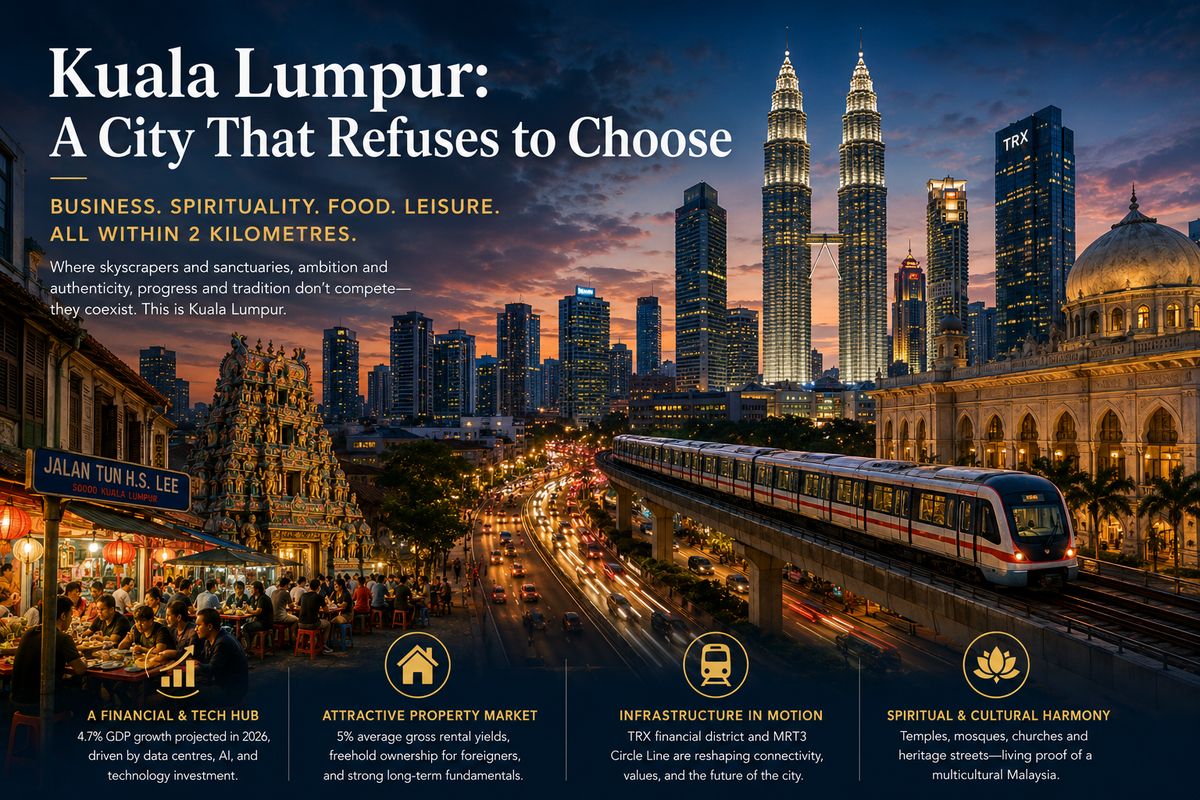
Most cities that succeed do so by specialising. They pick a personality, discard the rest, and spend decades perfecting the sacrifice. Kuala Lumpur has taken the opposite bet. In a single afternoon here, a fund manager can close a semiconductor financing deal in a glass tower above Tun Razak Exchange, eat char kway teow off a plastic stool twenty minutes later, walk past a nineteenth-century Hindu temple on the way back to the office, and hear the Maghrib call to prayer roll across the skyline before dinner. None of this requires leaving a two-kilometre radius, and none of it feels staged for visitors. It is simply Tuesday.
That compression is the actual product Kuala Lumpur is selling. Not one strength dressed up as several, but four genuine ones, business, property, spirituality and food, stacked on top of each other rather than sorted into separate districts the way most global cities insist on doing. What makes the city worth writing about now, rather than as a nostalgic footnote to Southeast Asian growth, is that all four dimensions happen to be appreciating at once, and the price of entry has not yet caught up with that fact.
A Financial Centre Building Itself in Real Time Kuala Lumpur is not coasting on its old reputation as a pleasant, affordable alternative to its neighbours. It is mid-construction on a different identity altogether, and the shift shows up in numbers that read less like ambition than arithmetic.
Malaysia's economy is projected to grow at around 4.7 percent in 2026, with the IMF crediting data-centre investment, AI infrastructure and the broader technology upcycle as the drivers, and naming Malaysia among the region's leading net exporters of AI-related hardware, alongside South Korea, Taiwan and Thailand. That is a materially different economic identity than the one the city held even five years ago. This matters beyond Malaysia's borders. A moratorium on new data-centre projects in Singapore between 2019 and 2022 redirected hyperscaler expansion across the causeway, and the Klang Valley, taking in Kuala Lumpur, Petaling Jaya and Cyberjaya, became one of the chief beneficiaries. Selangor, Johor and Kuala Lumpur now lead the country in approved investment, with Kuala Lumpur alone securing billions of ringgit in fresh capital in early 2026. Tellingly, regulators are now layering sustainability requirements onto new approvals rather than chasing volume for its own sake, the unmistakable signature of a market moving past its speculative adolescence and into something more durable.
The physical expression of this ambition is Tun Razak Exchange, a financial district built from bare ground and explicitly designed to let Kuala Lumpur compete with Singapore and Hong Kong, with a particular edge in Islamic finance, where Malaysia is already the world's largest hub. Alongside it, the MRT3 Circle Line is under active construction, expected to reshape commuter patterns and property values through the end of the decade. Seen from a distance, this is simply infrastructure spending. Seen up close, it is a country deciding, deliberately, to become something it was not a decade ago, and choosing to do it before the rest of the region notices. Property: Undervalued, but No Longer Naive.
For an investor, the Kuala Lumpur property story in 2026 is more textured than a simple growth chart, and that texture is precisely what makes it interesting. The market has entered what analysts describe as a more balanced phase. Overall residential prices moved only marginally over the past year, condominiums and serviced apartments roughly flat to slightly down, while landed homes in established neighbourhoods such as Bangsar, Damansara Heights, Taman Tun Dr Ismail and Desa ParkCity have held firm and, in places, edged higher, for the plainest of reasons: there is almost no new land left to build more of them.
This is not a market that rewards blind entry, and it no longer pretends otherwise. Housing starts fell sharply in the first quarter of 2026 compared with the year before, developers have grown more disciplined about what they bring to market, and oversupply remains a genuine risk in specific pockets, particularly investor-grade serviced apartments in areas like Cheras or Old Klang Road, where too many near-identical units chase too small a pool of tenants. The counsel from those who track the market closely is consistent: buy well-managed stock near MRT or LRT stations, in suburbs with real owner-occupier demand, and hold for five to seven years rather than trade it like a position.
What justifies that patience is the underlying arithmetic. Gross rental yields across Malaysia average around five percent, among the more attractive figures in the region, and Kuala Lumpur specifically offers the country's deepest tenant pool and its most sustained rent growth, functioning almost as a barometer for the wider economy's health. Foreigners can buy freehold property in the city with a minimum investment of one million ringgit, a lower threshold than neighbouring Selangor, and the ringgit's recent strengthening trend has added a further layer of stability for anyone thinking in years rather than quarters. Infrastructure is already doing real work here: properties within reach of confirmed MRT3 stations command meaningful premiums over comparable developments without transit access, even before a single train has run, which tells you the market is pricing connectivity as fundamental rather than aspirational.
None of this makes Kuala Lumpur a sure thing, and no honest account of the market should suggest it does. But it does make the city a rare kind of proposition: a capital with functioning, global-grade infrastructure, yields most Western investors would consider excellent, and a price floor that has not yet caught up with what it is becoming.
Where Business Kneels Beside Worship If Kuala Lumpur's economic ambitions explain where the city is going, its religious geography explains what it has always been. This is not a city with diversity confined to festival calendars or heritage trails. The major faiths of Southeast Asia occupy the same few square kilometres of the historic core, and have done so for well over a century, without one crowding out the others.
Masjid Jamek, among the oldest mosques in the city, stands at the literal confluence of the Klang and Gombak rivers, the geographic meeting point that gives Kuala Lumpur its name, muddy confluence. A short walk away is Sri Mahamariamman Temple, the city's oldest Hindu temple, its gopuram tower a riot of sculpted deities that has watched over Chinatown since the 1870s.
Nearby, Chinese temples serving Buddhist, Taoist and folk-religious practice have stood since the earliest days of the tin-mining boom, when migrant communities built houses of worship among their first permanent structures. Thean Hou Temple, one of the largest Chinese temples in Southeast Asia, sits on a hill above the skyline, still a working temple rather than a relic, busiest during Chinese New Year and the Nine Emperor Gods Festival. Beyond the city limits, Batu Caves draws pilgrims into its limestone cavern shrine to Lord Murugan during Thaipusam, one of the most significant Hindu festivals held anywhere outside India.
This proximity was never curated for visitors. It reflects how the city actually runs. Eid, Chinese New Year, Deepavali, Wesak Day and Christmas are all national holidays, and each community's principal festival functions as a shared civic event rather than a private one. It is worth pausing on what this quietly represents: in an era when many cities manage diversity as friction to be minimised, Kuala Lumpur built its downtown around the assumption that difference could simply coexist, and has not needed to relitigate that assumption for over a hundred years.
A morning on Jalan Tun H.S. Lee makes the pattern legible without a word of explanation. Incense drifts out of Sri Mahamariamman's gopuram at seven, mingling with the smell of frying dough from a coffee shop that has occupied the same corner lot for three generations. By eight, office workers in lanyards queue for the same kopi as the temple's caretakers. A muezzin's call reaches the street from two directions at once, from Masjid Jamek and from a smaller surau tucked behind a row of shophouses, neither drowning out the other. Nobody on the street appears to notice any of this as remarkable. That, more than any monument, is the city's real achievement.
Food as the City's Great Equaliser If religion is where Kuala Lumpur reveals its depth, food is where it reveals its democracy. Malay, Chinese and Indian culinary traditions did not merely coexist here, they collided, producing hybrids that belong to no single lineage and to all of them at once, most visibly in Peranakan and mamak cuisine.
The hawker centre functions as the city's real town square. Jalan Alor turns into a night-long open-air kitchen serving grilled skewers, noodle soups and seafood to a mixed crowd of office workers, tourists and taxi drivers, often at prices that would be unthinkable in a comparable food scene in Singapore or Hong Kong. Nasi lemak, the closest thing Malaysia has to a national dish, coconut rice with sambal, anchovies, peanuts and egg, is sold from street carts for the price of a coffee and reinvented as fine dining a few streets over, sometimes by the same family. Mamak stalls, run by the city's Indian Muslim community, stay open into the early hours serving roti canai and teh tarik to whoever is still awake, one of the few genuinely classless social spaces left in an increasingly stratified city.
This is the part of the value proposition that resists a spreadsheet. A meal that would define a special occasion in London or New York is a Tuesday lunch in Kuala Lumpur, and it is not a diminished version of quality, it is often superior, because the tradition being served has had a century to refine itself in place. Bang for the buck, the idea that anchors this entire piece, is nowhere more literal than at a hawker table.
Why This Decade, Specifically Cities do not become important on a single date. But some five-year windows matter more than others, and 2026 to 2030 looks like one of them for Kuala Lumpur. AI-driven data-centre investment is arriving at a scale the city has not seen before, precisely as Tun Razak Exchange nears completion and MRT3 begins to make good on its promised connectivity premiums. Johor's spillover from the Johor-Singapore Special Economic Zone is drawing regional attention northward along the same corridor, lifting Kuala Lumpur's profile as the more established, better-connected counterpart. The ringgit, after years of volatility, has entered a genuine strengthening trend. None of these forces alone would be decisive.
Together, they describe a country and a capital repositioning at the same moment, which is precisely the kind of window that, in hindsight, tends to look obvious only after it has closed.
The Synthesis None of these four dimensions is really a separate story about Kuala Lumpur. They are the same story told four times. A capital building a genuine financial and technology sector without pricing out the culture that makes it worth living in. A property market where global-grade assets still trade at regional prices, with real yield attached rather than speculative hope. A spiritual landscape where several deep traditions occupy the same few streets without one displacing another. A food culture where the best meal in the city might cost less than the taxi ride to reach it.
Most cities eventually have to sacrifice one of these dimensions to build the others. Singapore traded texture for order. Bangkok has struggled to build financial infrastructure to match its cultural depth. Dubai built the infrastructure first and is still assembling the soul. Kuala Lumpur's real advantage, legible to an investor, a pilgrim, or simply a hungry traveller, each in their own language, is that it never had to choose.
The next generation of great cities may not be defined by how fast they grow, but by how much of themselves they manage to keep while doing so. On that measure, Kuala Lumpur is already ahead, and has not yet been asked to pay for it.