
What the Frame Cannot Hold
Beyond every photograph lies a life of memories, hopes and quiet achievements. Centaury People honours the extraordinary humanity found in ordinary lives.
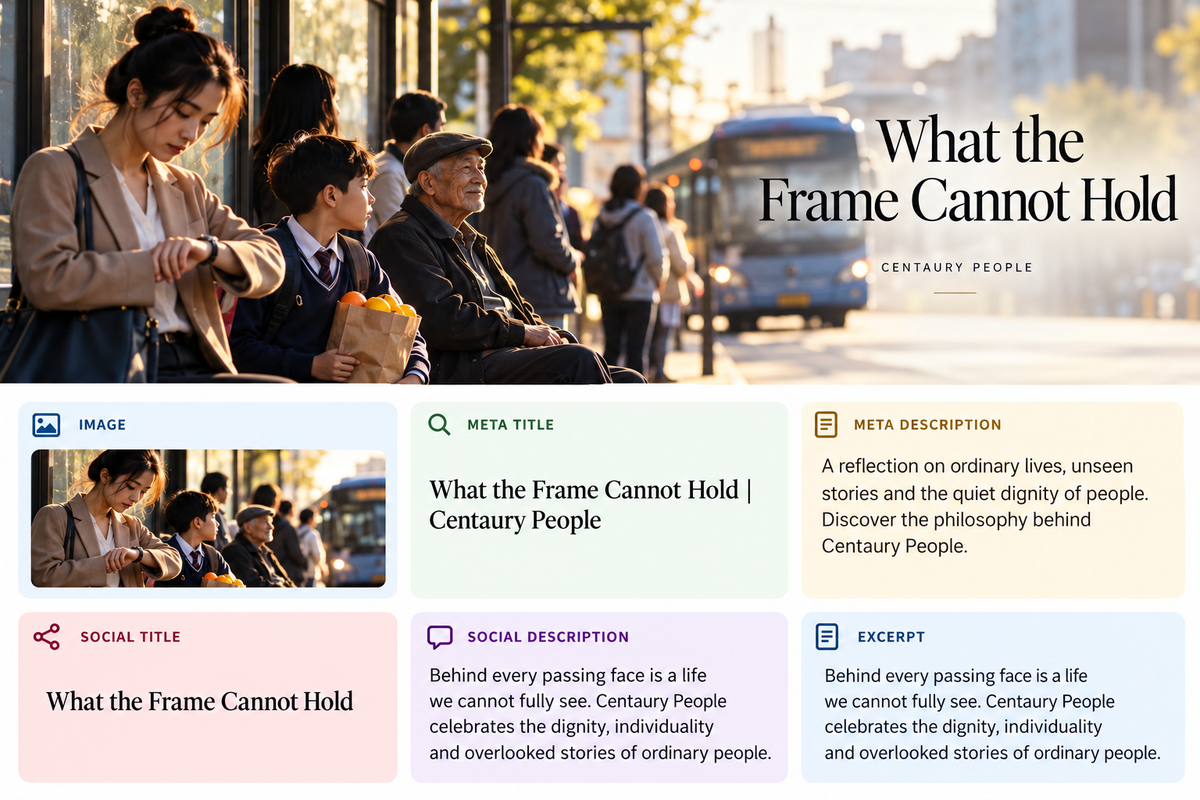
On a bright morning, a bus stop becomes a small parliament of strangers. A woman checks the time twice in a minute. A boy in a school uniform balances a paper bag of oranges against his hip. An older man has taken the shaded end of the bench and seems to be in no hurry at all. When the bus arrives, they climb aboard and scatter across the city, and by evening none of them will remember the others. For a few minutes, though, a whole range of human life stood together on the pavement, unannounced and largely unseen.
Most of what happens in such a scene escapes us. We register a coat, a gesture, the set of someone's shoulders, and the mind quietly fills in the rest. The woman checking her watch may be late for an interview, or she may simply like to know where the day stands. The man on the bench may be resting after a night shift, or enjoying the first idle morning of his retirement. Appearance offers a door, never the room behind it.
Centaury People begins from that recognition. It is a storytelling project devoted to people who rarely become subjects: the vendor who knows every regular by their order, the retired teacher who still corrects the grammar on restaurant menus, the couple who have walked the same evening route for decades, the young professional learning a new city one wrong turn at a time. Its attention is not reserved for the celebrated or the photogenic. It is drawn to the ordinary textures of a life, the work done well without witnesses, the patience it takes to raise a family, the wit that turns a long queue into a shared joke.
The work takes several forms. Portraits, short films and written reflections each offer a different way of looking. Some subjects are met in real life; others are imagined, including figures and scenes created with artificial intelligence, and these are always presented as what they are. An invented portrait makes no claim to document a particular person. Its value lies in the question a carefully imagined face can prompt, the same question a real one does: who might this be, and what might they be carrying?
That question is asked gently. Centaury People does not presume to know anyone's circumstances, and it resists turning people into lessons. A weathered face is not automatically a tragedy, nor is a laughing one proof of an easy life. People are allowed their contradictions here: the cheerful neighbour who is privately lonely, the stern shopkeeper who slips an extra sweet to a child, the stranger having a hard day who still holds the door. Struggle is acknowledged without becoming the whole of anyone's identity.
There is plenty to admire once one starts looking. Resilience rarely announces itself; it shows up as someone opening the shop again after a slow month. Kindness is often practical: a lift offered, a seat given up, a message sent to check in. Creativity lives in the improvised repair, the hand-painted sign, the recipe adjusted to whatever the market had that day. None of this wins prizes, yet it is what holds a neighbourhood together.
To notice such things is a modest act, and perhaps an important one. Where worth is so often measured by reach and recognition, paying attention to someone who will never trend is a quiet form of respect. It reminds the observer that a crowd is made of individuals, each with a history reaching far beyond the moment glimpsed.
Tomorrow the bus will come again, and a new set of strangers will gather beneath the same shelter, each carrying a life no passer-by can fully see. Centaury People holds to a simple belief about them, and about all of us: every story is worth attention, including the ones we pass on the way to somewhere else.