The View From the Causeway: Johor Bahru
The most important policy development in this story is the Johor–Singapore Special Economic Zone,
Stand on the Johor Causeway a little before seven in the morning and you will understand something that no spreadsheet can teach you. Thousands of people move past in both directions at once — motorcyclists weaving between lanes of stalled cars, office workers on foot with lanyards already around their necks, students half-asleep against bus windows. Somewhere in that crowd is a rhythm that has repeated itself, more or less unchanged, for generations: Johor Bahru waking up and sending part of itself across the water to Singapore, and Singapore, in its own quiet way, depending on that daily arrival more than it likes to admit.
It is easy to miss what this scene actually is. From a distance, it looks like traffic — an inconvenience, a bottleneck, something to be endured before the working day can properly begin. Look closer, though, and it is something rarer: two economies, two currencies, two governments, and four languages meeting each other every single morning, without ceremony, because that is simply what the neighbourhood requires. Few borders in the world carry this much human weight so quietly.
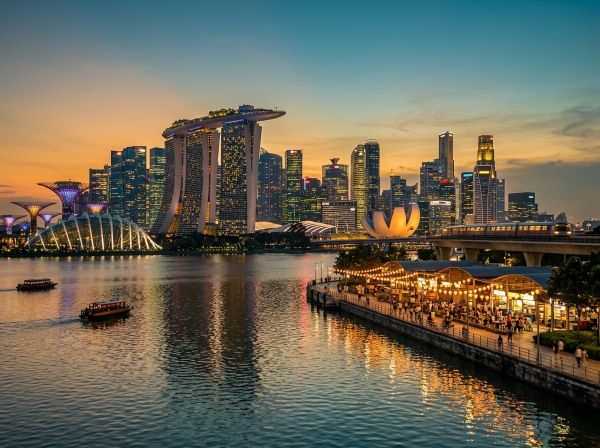
At sunrise, from certain points along the Johor waterfront, the Singapore skyline sits low and silver across the strait — close enough to feel almost touchable, far enough to remain, for now, a different country. There is something quietly instructive in that view. It is a reminder that proximity to success does not automatically confer it. Johor Bahru has watched Singapore's rise for decades from exactly this vantage point — near enough to feel every ripple of its neighbour's prosperity, far enough to have spent years wondering when, or whether, its own moment would arrive.
Sit in a café in central Johor Bahru on any given afternoon and you will hear the answer forming in real time, in the most unglamorous way possible: through conversation. Malay at one table, English at the next, Mandarin drifting over from a group of retirees, a smattering of Tamil somewhere near the counter. This is not a curated diversity showcase. It is simply what a border city sounds like when it has spent a century absorbing whoever needed to pass through it, live in it, or build something inside it. Cities like this tend to be underestimated for a long time — and then, eventually, they are not.
There is an old and useful piece of wisdom about how change actually happens, one that applies as much to cities as it does to people or companies: nothing important happens overnight, and everything important eventually looks like it did. For years, the story of Johor Bahru was Singapore's cheaper cousin — a place for a weekend meal, a tank of petrol, a bit of cross-border shopping. That story was true, but it was incomplete. It described what Johor Bahru was being used for, not what it was quietly becoming.
Geography, more than most people credit, is destiny in slow motion. A city that happens to sit beside a wealthier, more constrained neighbour rarely stays untouched by that neighbour's growth forever. Sooner or later, the larger economy runs out of room — literally, physically, in square kilometres — and the overflow has to go somewhere. It goes to whichever nearby place has the land, the labour, and eventually the political will to receive it well. This is not a new pattern in economic history. It has simply taken Johor Bahru a long time to reach the point in that pattern where the story turns.
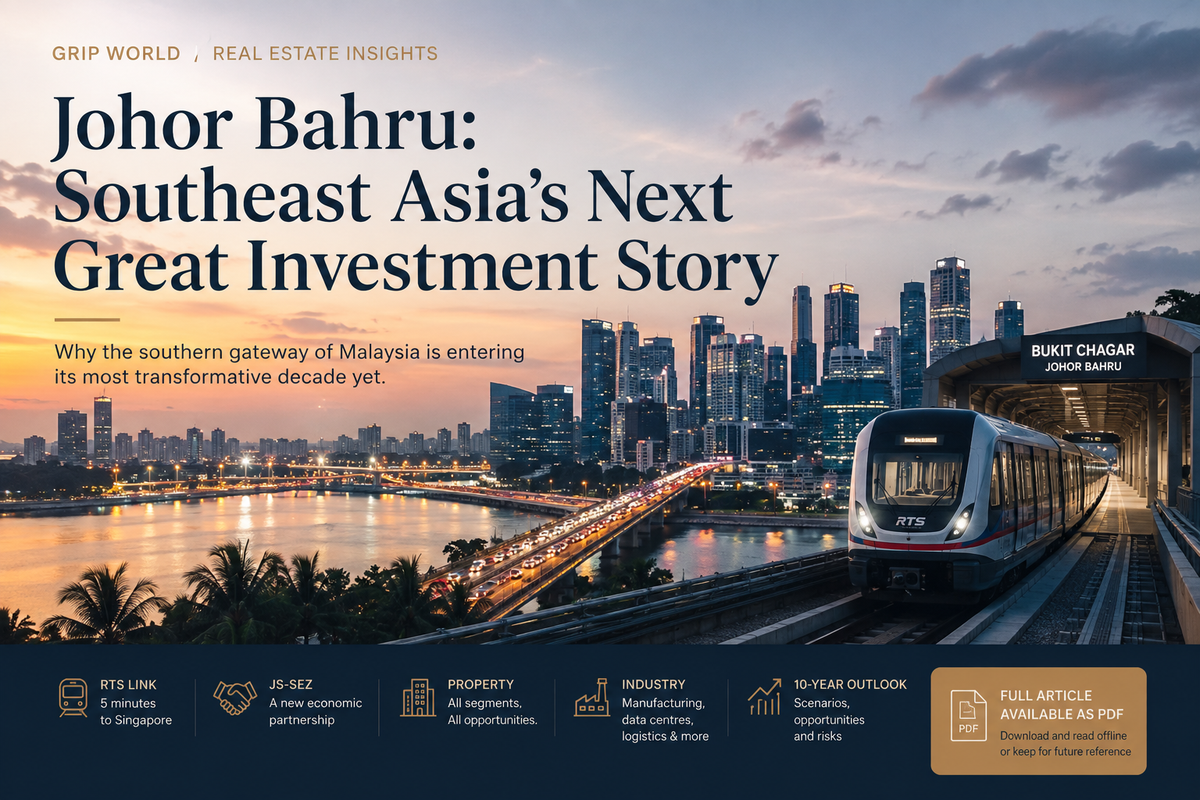
That turn is what is happening now. Not loudly, not all at once, but in the way that real structural change usually arrives: a rail line under construction between two stations that used to require an hour of traffic to connect; a tax framework, years in the negotiating, finally signed by two governments that do not always move quickly together; a growing number of families, quietly and individually, deciding that the commute is worth it. None of these things, on their own, would be a headline. Together, they are the early architecture of a different kind of city than the one that existed even five years ago.
It would be a mistake to romanticise this. Johor Bahru is not on the verge of becoming Singapore, and nothing in its trajectory suggests it wants to be. Its opportunity is not to replicate its neighbour but to complement it — to be the place where Singapore's constraints become someone else's advantage, where a smaller budget still buys a real home, where a manufacturer priced out of Singapore's land market can simply drive, or soon ride, twenty minutes further and keep growing. That is a quieter kind of promise than the ones usually attached to emerging investment stories, and it is, for exactly that reason, a more believable one.
This matters beyond the people who happen to be shopping for property. It matters to anyone curious about how Southeast Asia's next decade of growth is likely to be distributed — not concentrated entirely in a handful of already-famous capitals, but spilling, as it often does, into the overlooked places sitting just beside them. It matters to entrepreneurs weighing where to build a team, to professionals wondering whether a cross-border life is more possible now than it was a few years ago, and to anyone who simply finds it interesting to watch a city change in real time rather than read about it afterward, once the outcome is already obvious.
What follows is a long, detailed, deliberately unhurried look at exactly how that change is unfolding — the policy, the infrastructure, the property market, the risks that deserve to be taken seriously alongside the opportunities, and the honest uncertainties that no responsible article should paper over. It does not promise an outcome. It tries, instead, to show the shape of a story still being written, so that you can judge for yourself where it might go. If the scene on the Causeway this morning is any indication, it is a story worth understanding before, rather than after, the rest of the world catches on.
The complete long-form research article is also available as a downloadable PDF, for readers who prefer an offline reading experience or would like to keep a copy for future reference.