The Riverside Gurukul: Learning at the Water's Edge
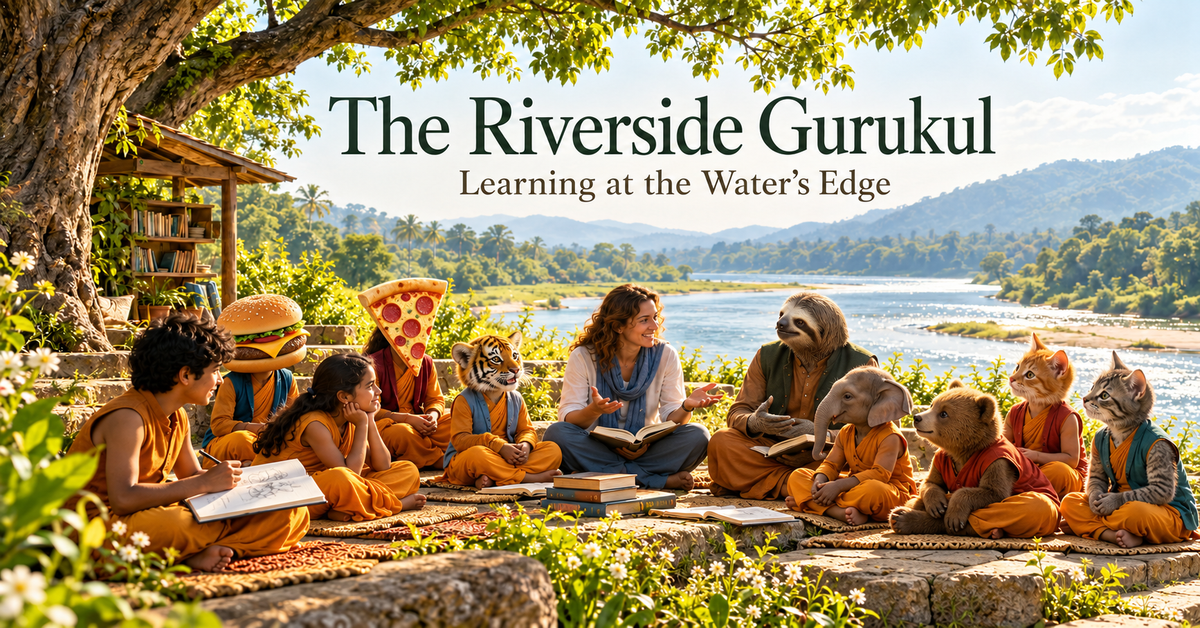
The Riverside Gurukul begins in the imagination, where it is easy to picture. A broad river slides past a grassy bank. Old trees give shade, worn stone steps lead down to the water, and a covered shelf keeps the books dry when it rains. Mornings smell of wet earth. By mid-afternoon the light on the water is too bright to watch for long, and people turn their mats towards the trees.
Anyone may come. A girl of nine sits beside a retired bus conductor, and a young mother arrives with her baby and a notebook. Nobody is asked about schooling, income or family before sitting down. What counts is a willingness to listen and to say honestly what one thinks.
Learning often begins with something someone has noticed. One morning a boy points out that leaves near the bank drift slowly while those in midstream race away, and he asks why. Instead of handing him an answer, the group drops twigs at different distances from the shore and times them by counting aloud. A teenager sketches their paths in her notebook, and the drawing makes the pattern easier to see. An older learner suggests that the bank and riverbed slow the water nearest them. Then a woman remarks that the river ran much higher when she was a girl. Her memory is worth hearing, yet knowing how the river has changed would require records, old photographs and other people's accounts. A scientific claim asks for evidence that others can check. A historical claim asks for reliable sources, read in context.
Other days begin with a story. In one folktale a clever man tricks his neighbour out of a field, and the children laugh at his cunning. A woman who sells vegetables at the market then describes being short-changed by a smooth talker, and the laughter turns into an argument about whether cleverness can excuse unfairness. This time nobody settles it; people give reasons, revise their views a little and agree to return to the question.
Language opens its own doors. A Hindi speaker explains that she has three ways to say "you": tu, tum and aap. Roughly, aap carries respect, tum suits friends and equals, and tu can signal great closeness or, aimed at the wrong person, an insult. Much depends on the relationship, the moment and the habits of a region or family. An English speaker realises that his single word hides a set of choices, and the talk moves from grammar to how cultures show regard.
Before the talk begins, some people sit quietly by the water. Some recite prayers from their own traditions; others watch the current or keep reading on the steps. Taking part is a choice, and declining is unremarkable. Spiritual traditions are welcome here for the meaning and practices they offer, while questions about how the river moves are still answered with twigs, counting and evidence anyone can test.
What holds these moments together is the way people treat one another. The American philosopher John Dewey observed that putting an experience into words for someone else changes the speaker's own understanding, so that genuine communication educates both parties. The Brazilian educator Paulo Freire criticised teaching that treats learners as containers to be filled, and described dialogue in which teachers are taught by their students. At the Gurukul, the person who knows most about a subject still listens, because someone else may bring experience from work or family that the expert lacks. A basic question costs nothing, and disagreement is answered with reasons.
Imagining such a place has a practical use. UNESCO's guide to inclusive education rests on the principle that "every learner matters and matters equally." The UNESCO Institute for Lifelong Learning describes learning that reaches people of all ages, in families, communities and workplaces, through formal, non-formal and informal means. Dewey noted that adults resent any suggestion that they have no further possibilities of growth. The Gurukul turns these ideas into ordinary actions: a twig dropped into the current, a word compared across languages.
None of this needs a river. A kitchen table could hold the same habits of asking and listening. The river simply makes one fact harder to forget: the water passing the steps this evening is not the water that passed them at dawn, and the people who sat there watching it have changed a little too.
Sources John Dewey, Democracy and Education (1916): chapter 1 on communication as educative; chapter 4 on adults and growth Paulo Freire, Pedagogy of the Oppressed, chapter 2, on the "banking" concept and dialogue UNESCO, A Guide for Ensuring Inclusion and Equity in Education (2017) UNESCO Institute for Lifelong Learning, Promoting Lifelong Learning for All, defining lifelong learning