
The Caring Couch Seat 9 :Shaheen, 54 The Price of One More Day
Eight years after losing his 11-year-old daughter, Shaheen has everything money can buy and little desire to keep living. Beneath his anger and self-destruction lies a father's grief, a handful of memories, and the possibility of accepting help.
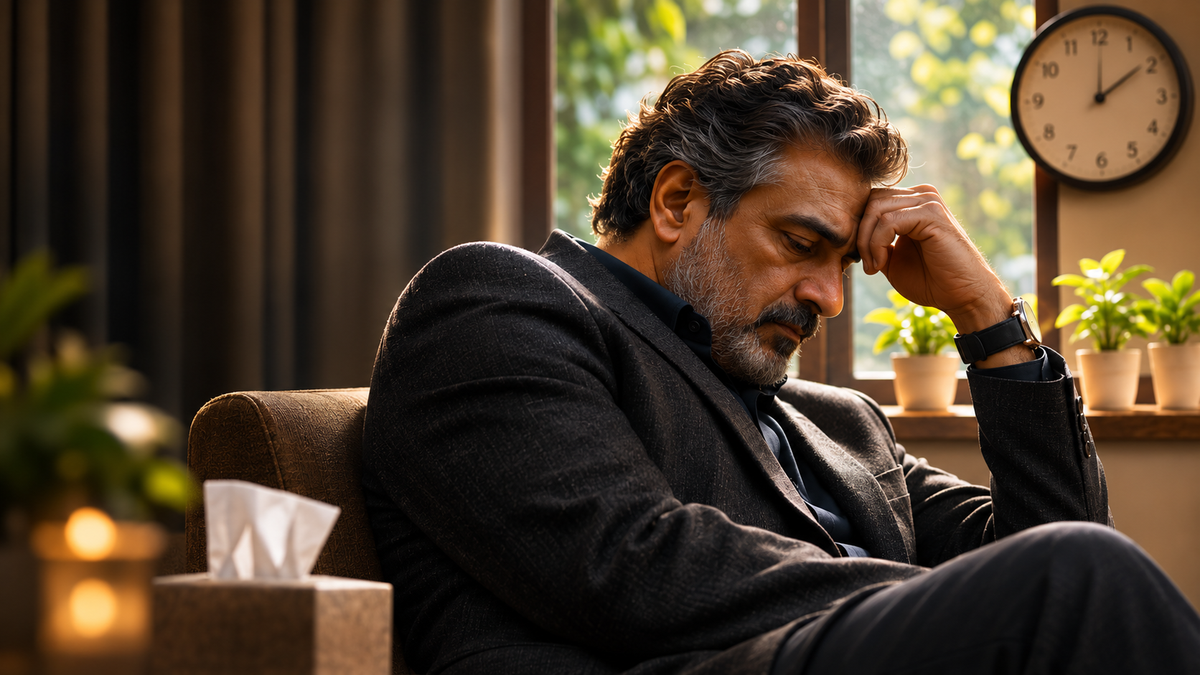
He arrived eleven minutes early and did not sit down.
The room was small: two armchairs, a low table with a box of tissues no one had touched, a window looking onto a neem tree, and a wall clock above the door. Shaheen stood beneath it in a charcoal suit that cost more than the furniture, his phone in his hand, screen dark.
"Your clock is four minutes slow."
"It has been for a while," the counsellor said.
"You should fix it."
"I keep meaning to."
"That's what everyone says about everything." He sat, finally, in the chair nearest the door. "My assistant booked this. I want to be clear that I didn't. I've seen a man in Zurich who charged me more for one afternoon than you make in a year. He told me grief is a journey."
"Was it?"
"It was a sentence. I paid for a sentence." He placed the phone face down on his knee. "So. What's your sentence?"
"I don't have one ready."
"Good. Then we'll save time."
She waited. The neem tree moved a little in the window. He watched her watching him and seemed irritated that she wasn't uncomfortable.
"You know who I am," he said.
"I know your name."
"Then you know I don't need anything."
"Your assistant seemed to think otherwise."
"My assistant is twenty-six and thinks everything can be fixed by booking it." A short breath through the nose. "My sister made her do it. My sister thinks I'm going to do something stupid."
"Is she right?"
He looked at her for a long moment. "You don't waste time either."
For the next while he talked, and most of it was contempt. He talked about the restaurant he'd walked out of last month because a family at the next table was celebrating something. A cake, candles, a waiter singing. He had paid his bill and theirs, he said, and left before the candles were blown out.
"That sounds almost generous," she said.
"It wasn't. I wanted them to stop." He turned his wedding ring, though he wasn't married anymore. "I wanted to buy their noise and switch it off."
"And when you couldn't?"
"I went home and broke a mirror." He said it as if reporting the weather. "Not dramatically. I just put my hand through it. My housekeeper cleaned it up. She's very good. She's been with me nineteen years. She doesn't look me in the eye anymore."
"Does that bother you?"
"It should." A pause. "I fired my driver in March. Twenty-two years. He'd driven her to school. He said her name in the car, just once, something about how she used to fight him for the radio. I told him to get out at the next signal. On the flyover. I left him there." He looked toward the window. "He has three daughters. He sent me a message on Eid. I didn't answer."
"What would you want to say to him?"
"Nothing he'd want to hear." Then, flatly: "That I'm sorry. That I couldn't stand that he still had all three."
The silence that followed was not comfortable, and she did not try to make it so.
"I hate them," he said eventually. "Healthy children. Other people's. I see a girl on a bicycle and I hate her parents for not knowing how lucky they are. And then I hate myself, and then I go to a meeting and destroy someone over a clause in a contract. That's my day. That's most days."
"It sounds exhausting."
"It's efficient. I've never been more productive."
"Tell me about her," the counsellor said.
"No."
"All right."
He sat back. Two minutes, perhaps three. The clock ticked its slow, wrong time.
"Zoya," he said. "Her name was Zoya. She was eleven."
The counsellor nodded and said nothing.
"It was eighteen months. Hospitals in three countries. I flew in a man from Boston on a private jet because someone told me he was the best. He was. It didn't matter." He was speaking very evenly now. "You learn a whole language. Counts and levels and percentages. I could read her charts better than the junior doctors. I used to correct them. I thought if I understood it well enough, I could negotiate with it."
"And you couldn't."
"There's nothing to negotiate with. That's what nobody tells you. You walk into the room with everything you have and there's no one on the other side of the table." His jaw moved. "She knew. Before I did. She stopped asking when she'd be going home and started asking whether I'd remember to water her plants. Ridiculous plants. Three of them, on her windowsill. Supermarket things."
"Did you?"
"They're still alive." He said it almost angrily. "Eight years. I water them myself. I don't let anyone else touch them. Isn't that pathetic? I've let my marriage die and my friendships die and I keep three ten-rupee plants alive like it's a religion."
"It doesn't sound pathetic to me."
"Then you're being kind, and I didn't pay for kind."
"You didn't pay for anything yet," she said. "Your assistant did."
For the first time, something like a smile — gone almost before it arrived.
"She used to set the clocks five minutes fast," he said. "Every clock in the house. Because I was always late picking her up from school. She said if the house lied to me, I'd be on time." He glanced up at the wall. "I'm early to everything now. I can't stop."
"Shaheen," the counsellor said, "your sister is worried you might kill yourself. I want to ask you directly. Are you thinking about ending your life?"
He didn't flinch. "Yes."
"Every day?"
"Most days. It's not dramatic. It's like a door in a hallway. You walk past it. Sometimes you stop."
"Have you thought about how?"
"Yes."
"Is that something you could reach? Is it available to you?"
He held her gaze. "There's a safe in my study. I made sure I would never have to ask anyone for anything."
"Have you thought about when?"
The pause was longer this time.
"Her birthday is on Thursday," he said. "She'd be nineteen. I've had a feeling about Thursday."
The counsellor leaned forward slightly. Her voice didn't change, but it became more deliberate.
"Thank you for telling me. I'm going to be straight with you, because I think that's what you'd want. Thoughts most days, a way to do it at home, and a date — that means you need more than me today. I'm going to ask the crisis team to come and see you here, before you leave. A psychiatric clinician. They'll talk with you properly and decide with you what keeps you safe tonight. Until then, I'm staying with you."
"I'm not a child."
"No. You're a man in a great deal of pain who has told me he has a plan."
"And if I walk out?"
"Then I'll call your sister, and I'll call emergency services. I would much rather do this with you."
He stared at her. The old contempt came up into his face and stayed there for a moment, and then it seemed to run out of fuel.
"You'd actually do it."
"Yes."
"Nobody tells me no anymore."
"I know," she said. "I think that might be part of the problem."
He argued every step. He argued about the crisis team — he'd seen psychiatrists; they all had the same clipboard. He argued about the hospital — he would not be put anywhere. He argued about his sister. They hadn't spoken properly in two years; he'd said unforgivable things at her son's wedding.
She did not argue back so much as hold her ground. She made the call to the crisis line from her desk, in a low, ordinary voice, while he sat with his arms folded and looked at the neem tree as if it had offended him.
"Forty minutes," she said when she hung up.
"I have a board meeting at six."
"You'll miss it."
He looked at the plants on her own windowsill — two of them, slightly overwatered.
"Nobody says her name," he said. "Not since I left the driver on the flyover. They're all frightened of what I'll do." He rubbed his eyes with the heel of his hand, once, hard. "I think if I start getting better, I'll forget her face. That's what I'm afraid of. Not dying. Forgetting."
"Is that what feels like it's happening?"
"No," he admitted. "It's the opposite. I remember everything. I remember the wrong things. The machines. Her hands at the end." His voice did not break, but it thinned. "I'd like to remember the clocks."
She let that sit before she answered.
"Then let's make room for that," she said. "Not only the hospital. The clocks. The plants. A girl who wanted her father home on time. You don't have to choose between her and staying alive. She's in both."
He didn't answer. He didn't need to.
She dialled. He took the phone from her when it connected, which she hadn't expected.
"Rukhsana," he said. A long silence on his end; a voice on the other, rising. "Yes. I know. I know. I'm — no, listen. I need you to go to the house. Tonight. There's something in the study I need you to take away." He closed his eyes. "I'll tell you the combination. Write it down."
He said the numbers slowly. Then he said, "I'm sorry about the wedding," and handed the phone back before she could reply.
The counsellor spoke to Rukhsana for several minutes — practical things. The crisis team was on its way. Nothing would be decided about tonight until they had seen him. Rukhsana would go to the house now and call back once the safe was empty.
The clinician arrived a little after five: a quiet man with a canvas bag and no clipboard, which Shaheen noted aloud. The counsellor left them alone. Through the door she heard Shaheen's voice rise twice and fall again. Rukhsana rang to say it was done; whatever had been in the safe was in the boot of her car, and she would keep it.
It was nearly an hour before the clinician came out. He had spoken to Rukhsana himself. Shaheen would not go home alone tonight; his sister would stay at the house, and the clinician had given her a number to call at any hour. The psychiatrist would see Shaheen at nine tomorrow, not next week. The counsellor would see him on Wednesday, the day before the birthday, and on Friday, the day after. Thursday, Rukhsana would be with him all day. The crisis team would call on Thursday morning.
"He didn't like any of it," the clinician said. "But he agreed to all of it."
Shaheen came out behind him, pulling on his jacket. He was still, unmistakably, a difficult man; she could see him already rehearsing objections for nine o'clock, already resenting a psychiatrist he hadn't met.
"Thursday," he said to the counsellor, "she'll want to talk about Zoya."
"Would that be so bad?"
He didn't reply. At the door he stopped beneath the clock and looked up at it.
"Don't fix it," he said.
"No?"
"Leave it. Someone should be allowed to be late."
He waited in the corridor for his sister, early, as always. But he waited.
.