
The Caring Couch Seat 6 — Allan, 29
Allan sits with his knees close together, hands wrapped around a mug he hasn't drunk from. His eyes have the specific tiredness that doesn't look like sleepiness — it looks like something has been sanded down.
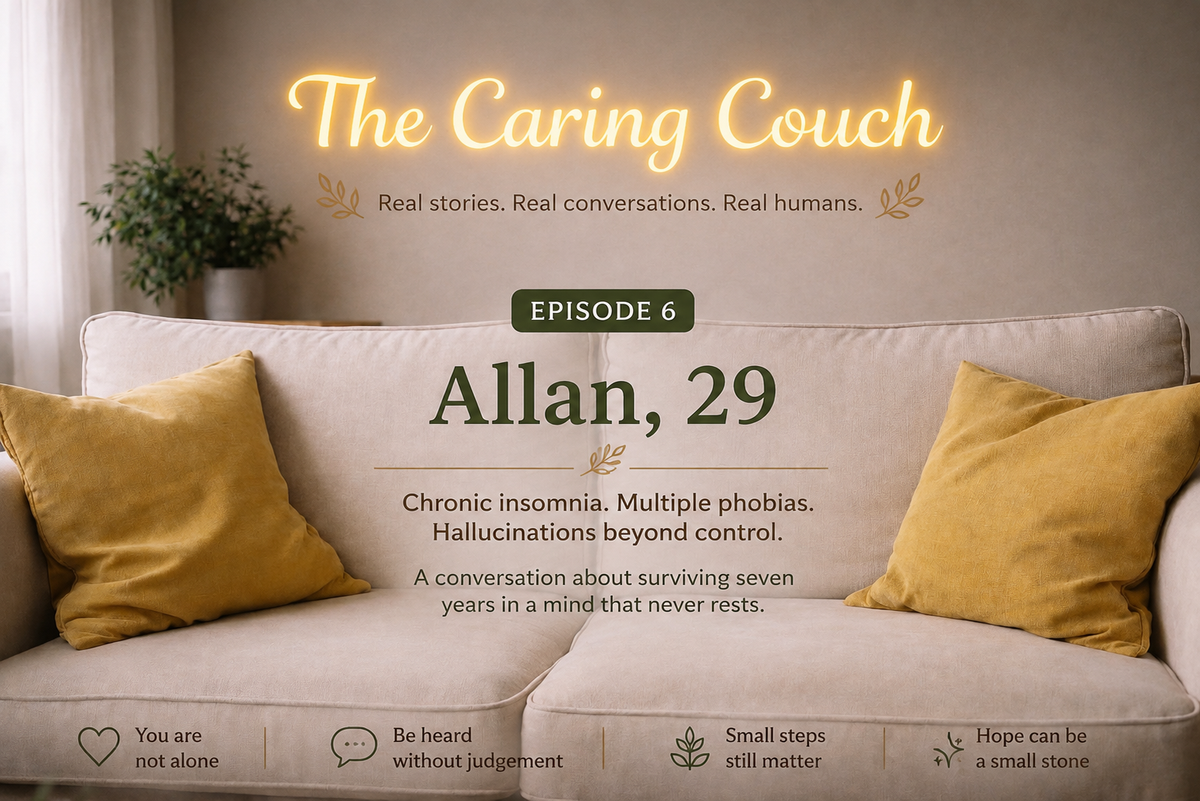
The room is small. Warm light, not fluorescent. A window cracked open somewhere, because Allan asked for it — he said closed rooms make him feel like the air is watching him. The counsellor doesn't ask why. Not yet.
Allan sits with his knees close together, hands wrapped around a mug he hasn't drunk from. His eyes have the specific tiredness that doesn't look like sleepiness — it looks like something has been sanded down.
Counsellor: You don't have to start anywhere in particular. Wherever it's sitting today is fine.
Allan: (small laugh, no humor in it) That's a generous offer. It's — yeah. Everywhere, today. Kind of everywhere.
Counsellor: Okay.
(A pause. The counsellor doesn't fill it.)
Allan: I used to think "my mind won't shut off" was just, like, a thing people say. A figure of speech. I didn't know it was literal until it happened to me. It's like — okay, this is going to sound stupid, but — there's no door. There used to be a door. Between being awake and not. And someone just took it off the hinges seven years ago and I've been standing in the doorway ever since. I don't know. That's the best way I've got of saying it.
Counsellor: Seven years in a doorway. That's a long time to not be fully in either room.
Allan: (looks up, surprised someone said it back like that) Yeah. That's — yeah.
(Silence. He turns the mug slowly.)
Counsellor: Can I ask what it was like, before the door came off?
Allan: Honestly I don't really remember. Isn't that awful? I know there was a version of me that slept eight hours and complained about waking up early. Like that was a real problem. A problem worth having, you know? I can't — I can't get back to what that felt like. It's like trying to remember a color you've never actually seen.
Counsellor: That sounds like its own kind of loss. Not just losing the sleep. Losing the memory of what having it felt like.
Allan: (quiet) Nobody's put it that way before.
(He sets the mug down. His hands are still.)
Allan: Two of my closest friends died. Car accident. I wasn't in the car. Wasn't even in the city that weekend. And I know — I know — that shouldn't be the thing that broke something in my brain, because I wasn't even there. Sometimes I feel guilty that I get to have this whole — reaction — when I wasn't the one who—
(He stops. Doesn't finish it.)
Counsellor: You don't need to have been in the car for something in you to have broken.
Allan: People say that. Doesn't feel true at three in the morning when I'm checking the locks for the eleventh time because some part of me is convinced something's about to happen. To me. Or someone I love. I know it's not rational. Knowing doesn't help, though. It just doesn't.
Counsellor: What happens in your body, when it's telling you something's about to happen?
Allan: Chest gets tight. Everything gets loud, even when it's actually silent, if that makes sense. Sometimes I — I see things. Not like ghosts, I'm not saying — I know they're not real. Shapes in the corner of the room. My name, said in a voice that isn't there. My doctor's explained the whole sleep-deprivation-and-hallucination thing to me like four times now. Doesn't make it less terrifying at two a.m. Knowing the science doesn't turn the light on.
Counsellor: No. Understanding a thing and being safe from a thing are two different jobs. And your mind's had to do the second one without ever getting to rest from the first.
(Allan looks down. His jaw tightens like he's holding something back.)
Allan: Sorry.
Counsellor: You don't need to apologize for anything you say in here.
Allan: I just — I've said all this before. To psychiatrists, psychologists, some guy at a retreat who had me chanting at 5 a.m., my mom, my sister, before she stopped asking. I've said it so many times it's started to feel like a script I'm performing. Not a thing that's actually happening to me. If that makes sense.
Counsellor: What would it be like if it wasn't a performance right now?
(Long pause. Allan's eyes go wet, though he doesn't cry.)
Allan: Exhausting. Honestly. If I let it be — real, right now, instead of the story I tell — I think I'd just. I don't know. Fall apart a little.
Counsellor: That's allowed to happen here.
Allan: (half-laughs) Everyone says that too.
Counsellor: Yeah, I bet they do. I'm not going to pretend I'm the first. I just mean it. Today. This room.
(The window rattles slightly. Neither of them reacts.)
Allan: I've tried everything, honestly. Medication, like six or seven different combinations. Therapy, a few kinds. Did the whole CBT-I sleep restriction thing — twice. Got sober for eight months 'cause someone convinced me the drinking was making it worse. It did help. For like three weeks. Then it stopped, like everything stops. I prayed, even — I'm not religious, but I got desperate enough to actually try it. Retreats. Ice baths, at one point, don't ask. Some guy's supplement protocol that cost me eleven hundred dollars and mostly just gave me weird dreams about my dentist.
Counsellor: (small, unexpected huff of a laugh) Your dentist.
Allan: (a real, tired half-smile, first one) Yeah. I don't know either. Anyway. Point is — none of it stuck.
Counsellor: That's a lot of things to have tried. That's not nothing, Allan.
Allan: Feels like nothing. Feels like failing, over and over.
Counsellor: I hear that it feels that way. Can I offer a different way of counting it? Not "I tried seven years of things and none of them worked" — more like, "I've been under this weight for seven years and I never once stopped trying to get out from under it."
(Allan is quiet. Really quiet. His hands have gone still in his lap.)
Allan: I don't know how to hear that without feeling like you're just — trying to make me feel better.
Counsellor: Fair. I'm not going to tell you you're resilient like it's some prize you should be grateful for. I'm just — notice this with me. You're still here. Still wanting to laugh again. Still wanting one good night's sleep. Still showing up to rooms like this one, even after every other room let you down. What do you make of that?
Allan: (voice cracks slightly) I don't know. I think I just — I don't know how to stop wanting it. The old life. The old me. Even after seven years I haven't managed to talk myself out of wanting him back.
Counsellor: Maybe that's not about failing to move on. Maybe that's just how much you loved being him.
(Allan puts a hand over his mouth for a moment. When he speaks again his voice is smaller.)
Allan: I miss him. That guy. I don't even know if he's still in here.
Counsellor: Do you think part of what's happening is that you never really got to say goodbye to your friends — and some of that grief is still looking for somewhere to go?
Allan: (a beat) I mean — sort of. It's not really that I didn't say goodbye, I was at the funeral. It's more — nobody let me stop. Not on purpose. It's just, work doesn't care, bills don't care. I went back three days later. I think I never actually finished it. Grieving. I just started not sleeping instead.
Counsellor: That's what I meant, I think — I just said it clumsily. That it's still unfinished.
Allan: No, it's — that's fine. That's actually right. Sort of a relief someone said it, however it came out.
(Allan turns the mug again, looking at it instead of the counsellor.)
Allan: There's this dumb thing. One of them — Marcus — used to text me every year on my birthday at like six in the morning, before anyone else was even awake. Every single year. Same message, basically. "Happy birthday, old man." Even the year he turned twenty-eight before I did, so technically I wasn't older yet. He didn't care. Just liked the bit. Anyway. My birthday's in three weeks. I keep thinking about how there's not going to be a text this year. There hasn't been for seven years, actually, but I still — I still sort of wait for it. At six a.m. Which, given everything, I'm awake for anyway. So.
(A silence. Not uncomfortable. Just full.)
Counsellor: That might be worth sitting with. Not solving today. Just sitting with.
Allan: Yeah.
(Silence stretches, but it doesn't feel uncomfortable this time. It feels like something settling.)
Counsellor: I'm not going to tell you tonight will be different. I don't know that, and I don't think you'd believe me if I said it.
Allan: (small, tired smile) No. I wouldn't.
Counsellor: But I'll say this. You walked in here already carrying seven years of something most people would've buckled under a lot sooner. That doesn't fix tonight. But it's true, whether or not you can feel it as true yet.
Allan: (quiet) I don't feel strong. Most days I feel like I'm just barely holding on.
Counsellor: Those might not be opposites. Barely holding on, for seven straight years — that's its own kind of strength. Most people never find out if they have it.
(Allan looks at the window. The light outside has shifted, gone a little softer.)
Allan: Can I say something that's gonna sound small?
Counsellor: Please.
Allan: Nobody's said it like that before. That the trying — even the trying that didn't work — still counts as something. I've spent seven years thinking every failed treatment was proof I was broken past fixing. Never really thought of it as... evidence of something else. Not sure I believe it yet. But I heard it.
Counsellor: You don't have to believe it today. Just let it sit in your pocket like a small stone. Something you can take out later. Three in the morning, when everything's loud again.
Allan: (nods slowly) A stone. Okay.
Counsellor: That's all today needs to be.
(He picks the mug back up. Doesn't drink from it. Just holds it, like something to anchor his hands.)
Allan: Thanks. I mean that. I don't know if anything's actually different. But for like — forty minutes — it felt like someone actually got what it's like in my head. Nobody's really managed that in a long time.
Counsellor: I'm glad you let me in for those forty minutes. That's not a small thing either.
(Allan stands. At the door, he pauses.)
Allan: Same time next week?
Counsellor: I'll be here.
End of Seat 6.