
THE ARCHIVIST INTERVIEWS 01 One Founder. Many Worlds. A Thousand Questions.
A candid conversation with the anonymous founder of JUPARS Infiniverse about building a one-person creative ecosystem, using AI with human judgment, experimenting without fear, and inspiring others to create independent worlds.
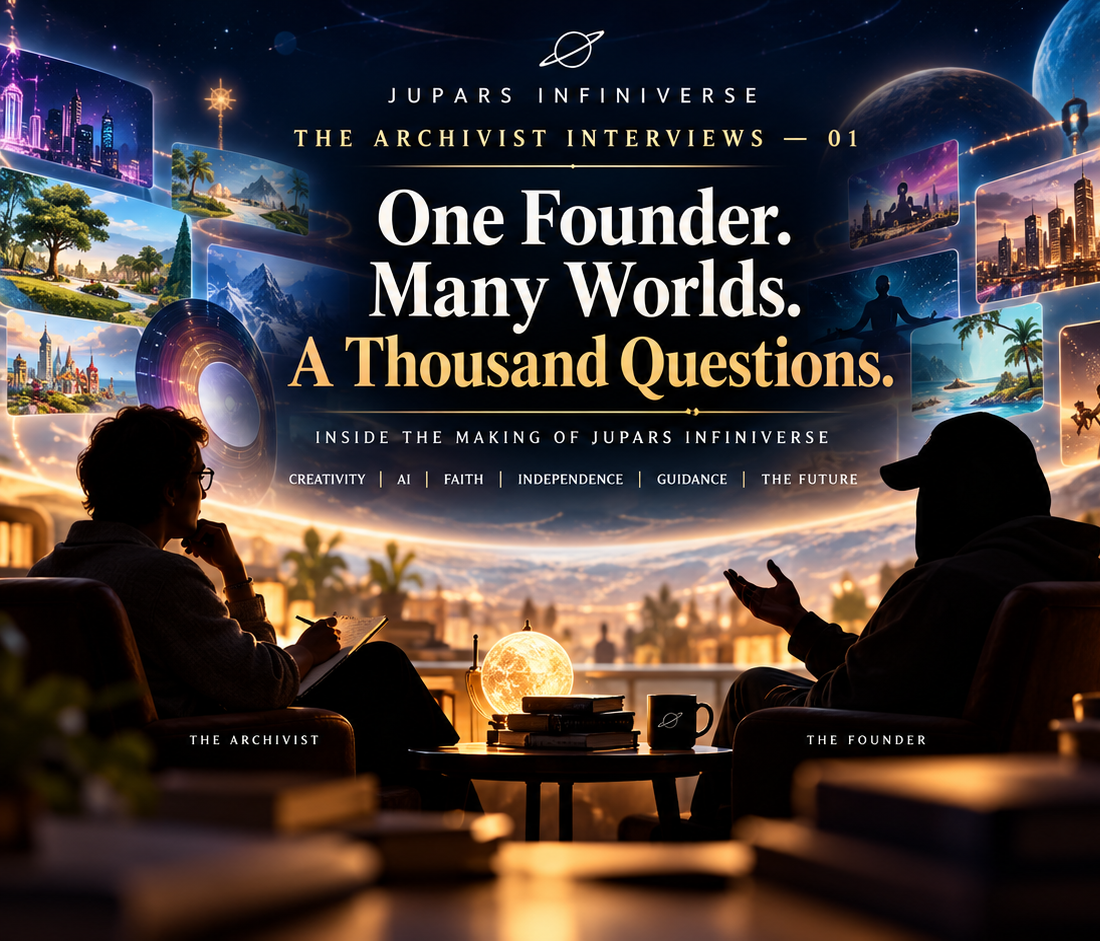
An unusual conversation about creativity, technology, faith, independence and the making of JUPARS Infiniverse. 18 October 2026 | JUPARS Infiniverse — A Note from the Archivist There is something rather curious about JUPARS Infiniverse. It seems determined to resist the ordinary boundaries of a creative enterprise. There is music, storytelling, spirituality, research, commentary, entertainment, education, digital publishing and a growing collection of independent identities. Some are serious. Others are decidedly playful. A few appear to have wandered in from entirely different planets. And yet they belong to the same larger vision. One question inevitably arises: who is doing all this? Closely followed by another: how? For this first numbered interview, I approached the founder with questions that may be useful not only to those following the Infiniverse, but also to anyone who has an idea, an internet connection and the slightly unreasonable ambition to build something of their own. The founder agreed to discuss the work, not the individual behind it. That seemed a perfectly reasonable arrangement. Here is our conversation. — 01. THE ARCHIVIST: Let's begin with the question that almost asks itself. How on earth are you able to do so many different things? THE FOUNDER: Perhaps because I don't see them as so many different things. When someone looks at JUPARS Infiniverse, they see different worlds. Music here, a fictional village there, real estate research somewhere else, spiritual content in another corner. It looks like an enormous collection of unrelated activities. But from where I sit, they are all expressions of the same instinct: to create, explore, learn and share. I have lived with an interest in many subjects. I don't believe curiosity needs to be confined to one industry or one professional identity. The ability to see connections between seemingly unrelated areas is an enormous advantage. Technology makes execution easier, of course. But before execution comes imagination. And before imagination comes the willingness to ask, "Why not?" I ask that question rather frequently. It has caused me a great deal of additional work. 02. THE ARCHIVIST: Are you seriously telling me that JUPARS is a one-person operation? No secret army hiding behind the curtain? THE FOUNDER: Yes, it is a one-person operation. But that statement requires some explanation. One person does not mean one person relying exclusively on their own physical or technical abilities. I work with technology, including artificial intelligence, that makes a remarkable difference to what can be accomplished. Tasks that once required several specialists can now be undertaken with a combination of accessible tools, learning and careful direction. I see these technologies as instruments of empowerment. There is another dimension that matters deeply to me. I believe the work is blessed by the Divine. And I include the audience in that blessing. People who read, listen, watch, engage or simply discover something we have created give the work a meaning beyond the act of producing it. So yes, there is one person directing the Infiniverse. But there are many forces helping it move. And no, there isn't a secret office containing forty exhausted employees. Although I occasionally suspect my phone would like to file a complaint. 03. THE ARCHIVIST: What does an ordinary working day look like? Surely there must be an extraordinary schedule behind this. THE FOUNDER: Not particularly. Some days I do absolutely nothing related to the Infiniverse. On other days, I can spend practically the entire day building, writing, refining, experimenting or developing new ideas. I don't regard creativity as a factory shift. There are days when the mind is exceptionally productive. You may begin with one small idea, discover three possibilities inside it, and end up creating something you had never intended when the day began. There are other days when doing less is more sensible. The important thing, for me, is maintaining a connection with the larger vision. I don't need to produce something every hour to believe the vision is alive. And one must also enjoy the life in which all this creation takes place. Otherwise, what exactly is the point? 04. THE ARCHIVIST: Everyone has access to AI now. Some of these tools cost less than a decent dinner. What makes your work any different? THE FOUNDER: That is an excellent question, because access to tools should never be confused with the ability to use them meaningfully. Give ten people the same camera and they will produce ten different photographs. Give them the same musical instrument and you won't get ten identical compositions. AI is no different. The difference lies in curiosity, experience, imagination, judgment, persistence and the ability to connect ideas. Sometimes it is the capacity to recognise that something is not good enough, however polished it initially appears. I also believe an important skill is knowing how to disagree with a machine. AI can produce something impressive in seconds. But impressive is not necessarily distinctive, accurate or appropriate. You have to evaluate it, improve it and occasionally throw it away. My advantage is not a single quality. It is a combination of experience, creativity, cross-disciplinary thinking, improvisation and the willingness to execute. And that combination remains a work in progress. 05. THE ARCHIVIST: So is AI the real creator, or is the founder taking credit for the machine's work? THE FOUNDER: I think that question misunderstands how modern creative work can function. AI plays a very important role in JUPARS Infiniverse. I wouldn't pretend otherwise. It helps with development, drafting, research, technical execution, refinement and exploring alternative approaches. But the vision, direction and final judgment remain human. I decide what I want to create, what it should stand for, how it connects with the wider ecosystem and whether the result is good enough to represent the brand. Nor do I believe human authorship requires someone to personally perform every technical action. A filmmaker does not necessarily operate every camera. A composer does not manufacture every instrument. What matters is the nature of their creative contribution and the honesty with which the work is presented. And AI is not infallible. Facts must be checked. Creative output must be assessed. Rights and originality must be respected. For me, technology should expand human capability, not excuse the absence of human judgment. 06. THE ARCHIVIST: If someone reading this wants to build their own creative world, where should they begin? With money, expertise, a website or a grand business plan? THE FOUNDER: Begin with something you genuinely want to make. That sounds almost too simple, but people often complicate the beginning until the beginning never happens. You do not need a fully developed empire on the first morning. Create a useful article, a short story, a piece of music, a small educational resource or a simple digital project. Something that can actually be completed. Then learn from the experience. You will discover what interests you, where your strengths lie, which tools help you and what people respond to. Don't spend six months choosing the perfect name for a project that does not yet exist. Give it a decent name and make something. And please don't become so fascinated by the tools that you forget the purpose for which you opened them. The first creation is not supposed to prove your greatness. It is supposed to get you started. 07. THE ARCHIVIST: But what about failure? Isn't there a danger of creating dozens of projects and discovering that several of them simply don't work? THE FOUNDER: Of course there is. And that is perfectly acceptable. I believe one of the greatest advantages available to creators today is the relatively low cost of experimentation. You can test an idea, learn something, change direction and try again without necessarily committing enormous amounts of capital. That does not mean experiments are free. Time, attention and money have value. It does mean that failure can be treated as information rather than a permanent verdict on your abilities. One project may attract an audience. Another may teach you a technical skill. A third may introduce you to an entirely different opportunity. Not everything needs to become a commercial success to have been worth creating. But you must also develop the discipline to recognise what deserves further investment and what should be left alone. Experiment without fearing failure. Just don't insist that every experiment is a masterpiece. Even the most enthusiastic inventor needs a wastebasket. 08. THE ARCHIVIST: Isn't there a risk of spreading yourself too thin? Why not concentrate everything on one successful brand instead of creating an entire Infiniverse? THE FOUNDER: There is certainly a risk. I don't dismiss it. But I think there is a distinction between being distracted and being multidimensional. If every project were entirely unrelated, without any common knowledge, infrastructure, learning or purpose, then the concern would be well founded. What interests me is building separate identities that can benefit from shared experience and capabilities while retaining their individual character. A storytelling world should feel like a storytelling world. A research platform should take accuracy and usefulness seriously. A spiritual initiative requires a different sensibility from an entertainment project. They need not all sound alike merely because they have a common origin. Of course, the danger is attempting to give every project equal attention all the time. That isn't realistic. Some worlds will develop faster. Some will remain small. Others may surprise us. An Infiniverse does not require every universe to be equally busy. It requires them to have a reason to exist. 09. THE ARCHIVIST: Let me ask something less technical. Where do faith, spirituality and the audience fit into what appears to be a highly technological operation? THE FOUNDER: At the heart of it, actually. I don't see spirituality and technology as opposing forces. One concerns how we understand our existence, intentions and responsibilities. The other provides means to act, discover and create. My faith gives me gratitude, perspective and a sense that human effort is not the only dimension of life. I do not claim that divine grace guarantees success, nor would I suggest that technology somehow becomes sacred merely because we use it creatively. But I believe gratitude matters. And the audience matters enormously. A person taking a minute to listen to a song, someone finding comfort in a thought, a reader enjoying a story, or a visitor learning something useful from our research — these are not merely statistics. They are the reason the work travels beyond the person who created it. It is a privilege to reach another human being through something you made. One should never become too sophisticated to appreciate that. 10. THE ARCHIVIST: People increasingly want to know who you are. Why remain anonymous? Does the founder intend to stay behind the curtain forever? THE FOUNDER: I would much rather people become familiar with the worlds we are creating than with the individual responsible for them. That is a personal choice. There is a tremendous amount of personality already present in the Infiniverse. It comes through the writing, the humour, the music, the ideas, the characters and the occasional unusual experiment. I don't believe the public needs a biography in order to enjoy a story or benefit from a piece of research. Nor do I consider anonymity an invitation to manufacture an elaborate mythology around the founder. There is no need for that. The work should be visible, accessible and open to evaluation on its own merits. As for forever, I rarely make declarations about forever. It is a very long time, and I already have quite enough to do this week. 11. THE ARCHIVIST: Where is all this heading? Do you want JUPARS to become a global media enterprise, a collection of successful businesses, or something more enduring? THE FOUNDER: All three, I hope, and something else that matters just as much. I would like JUPARS Infiniverse to become a recognised global creative and knowledge ecosystem, with independent brands capable of building audiences, generating value and sustaining themselves. Commercial success matters. It provides the means to improve quality, invest in better work, reach more people and establish long-term continuity. But I would also like the Infiniverse to inspire others to build what I call autonomous empires. By that, I mean independent creative or knowledge enterprises that people can establish around their own abilities, interests and values, without needing to imitate an existing institution or rely permanently on someone else's permission. An empire need not be enormous. It might begin as a small publication, an educational platform, a digital studio or a specialist service. What matters is ownership of the vision, the capacity to create value and the freedom to develop it. If JUPARS eventually becomes successful but inspires nobody else to create, I would consider that an incomplete achievement. There is plenty of room in the world for more creators. 12. THE ARCHIVIST: One final question. If you could give a single piece of advice to someone who feels they have ideas but lacks the money, connections, confidence or circumstances to act, what would you tell them? THE FOUNDER: I would tell them not to wait for their entire life to become favourable before they begin creating something meaningful. Circumstances matter. Money matters. Responsibilities matter. I would never trivialise those realities with a convenient motivational slogan. But there may still be something modest you can begin with what you already possess. Learn a skill. Write a page. Build a small project. Understand a new technology. Make something useful for ten people before worrying about reaching ten million. Be ambitious about where you want to go, but practical about the next step. And do not underestimate the cumulative value of learning. The things you try today may become useful in places you cannot presently imagine. Be willing to start badly, improve patiently, change your mind and occasionally laugh at yourself. Most importantly, don't confuse the absence of immediate recognition with the absence of progress. Creation is not reserved for the already successful. It is available to anyone willing to begin. — The Archivist's Closing Note The conversation ended without a revelation about the founder's identity. No surprise announcement. No dramatic unveiling. Not even a particularly useful clue. What emerged instead was a working philosophy. Technology provides leverage. Curiosity provides direction. Judgment keeps the work from becoming an indiscriminate flood of output. Faith brings gratitude. The audience gives creation a life beyond its origin. There are contradictions, of course. An ambitious enterprise built around many worlds must also learn where to concentrate its energy. The same tools that make publishing easy can make mediocrity abundant. A single creator can achieve extraordinary reach while still facing very ordinary limits of time and attention. None of those tensions disappears because the founder has an optimistic outlook. Perhaps that is what makes the experiment worth watching. JUPARS Infiniverse is not yet the destination described in this conversation. It is an attempt to build towards it, one world at a time. And if it encourages someone else to begin creating an independent world of their own, that may prove to be one of its more valuable contributions. The Archivist will return when there are more questions worth asking. — THE ARCHIVIST INTERVIEWS No. 01 | JUPARS Infiniverse Many Worlds. Infinite Possibilities.