
MAURITIUS: WHERE ISLAND LIVING MEETS GLOBAL OPPORTUNITY
The waterfront is a good place to begin understanding Mauritius. Commerce and migration have shaped this island as profoundly as the ocean around it.
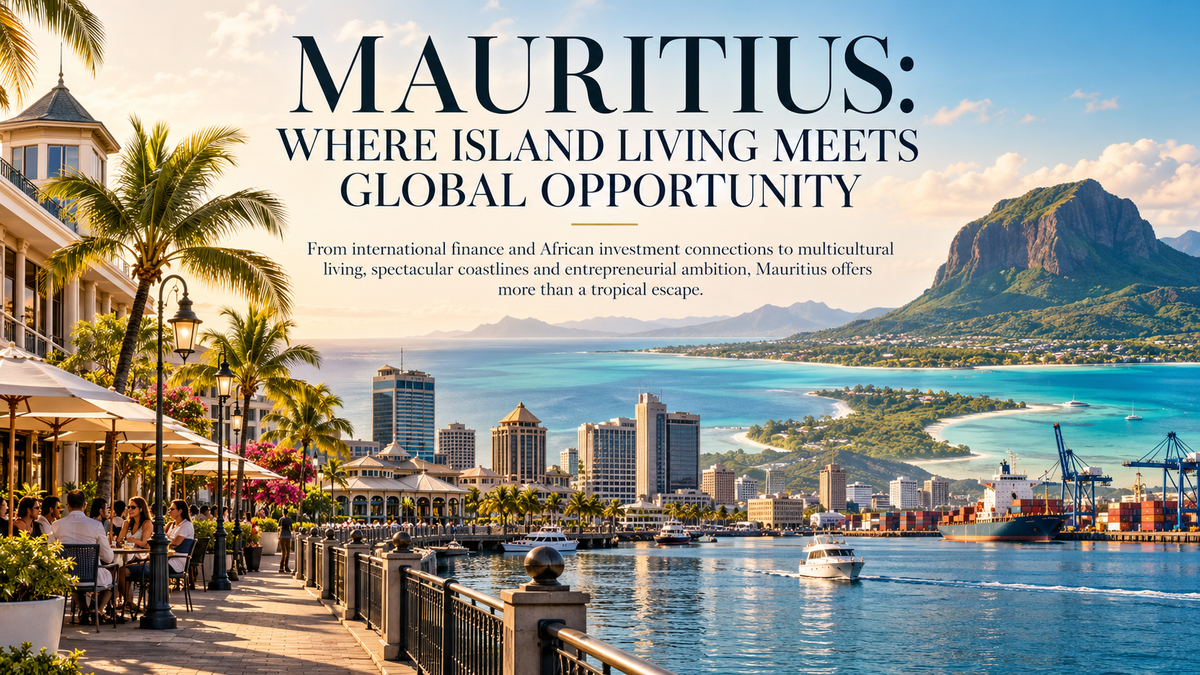
From international finance and African investment connections to multicultural living, spectacular coastlines and entrepreneurial ambition, Mauritius offers more than a tropical escape.
At Le Caudan Waterfront in Port Louis, cafés and shops face the harbour. Beyond them lies a working port; inland, the capital’s markets, banks and government offices fill the surrounding streets. Nearby, Aapravasi Ghat preserves the remains of the immigration depot through which indentured labourers entered the plantation economy.
The waterfront is a good place to begin understanding Mauritius. Commerce and migration have shaped this island as profoundly as the ocean around it.
An economy remade
Sugar financed an earlier Mauritius. Export-oriented textiles helped reshape it; tourism and international services widened its horizons. Today, manufacturing, finance, hospitality and information technology support a diversified economy, although older industries remain important.
Statistics Mauritius’s September 2026 national accounts, published in October, revised the historical series using a 2023 benchmark. They put real GDP growth in 2025 at 3.5%, replacing the previously published 3.2%. The forecast for 2026 is 3.0%; the year’s outcome remains to be measured.
For businesses accustomed to serving overseas markets, the next task is finding skilled people and improving productivity. An ageing population makes both increasingly important.
Capital with connections
Banks, investment funds, legal practices, corporate administrators and wealth managers give Mauritius an international financial presence unusual for a country of its size. Africa-facing businesses draw on professionals accustomed to arranging investments, administering funds and handling transactions across several legal systems.
The Financial Services Commission supervises non-bank financial services and global business; the Bank of Mauritius oversees banking. Civil-law and common-law traditions both influence commercial practice.
The treaty network requires careful interpretation. Tax treatment depends on the relevant agreement, domestic law, residence, economic substance and anti-abuse rules. Investment protections likewise depend on the instruments and circumstances involved.
For a company establishing operations here, access to experienced lawyers, accountants and fund administrators is a practical consideration alongside the legal structure.
Beyond the hotel gate
Away from the capital, the island offers several quite different versions of coastal life. Grand Baie combines restaurants, shops and boat excursions within a sociable northern base. Flic en Flac has a long western beach; Belle Mare, on the east coast, its own sweep of shoreline and resort hotels.
At Le Morne, the mountain rises above beaches and a broad lagoon. The UNESCO-listed landscape sheltered people escaping slavery, a history that changes how one sees its steep slopes. Inland, Black River Gorges National Park protects native forest, with around 60 kilometres of walking trails.
Luxury resorts bring polished hospitality, golf and sailing within easy reach. Smaller hotels and guesthouses offer a more intimate stay, often closer to village life. A few days inland or in Port Louis give a beach holiday greater depth.
A shared, complicated inheritance
The histories encountered at Le Morne and Aapravasi Ghat remain central to Mauritian identity. Colonial rule, slavery, indenture and migration connected African, Malagasy, Indian, European and Chinese lives here, often under deeply unequal conditions.
Kreol Morisien connects everyday conversations. French and English remain important in public life, education and business, alongside ancestral languages.
Dholl puri, rougaille, Chinese-Mauritian noodles and chilli fritters belong to a food culture that crosses inherited boundaries. Sega carries Creole histories through music and dance.
Diwali, Eid, Christmas, Chinese New Year and Cavadee mark the religious calendar. Familiarity between traditions coexists with community distinctions and historical inequalities. Visitors encounter this shared life in food, language and public celebrations, well beyond organised cultural performances.
Making a home
For families considering a longer stay, international schools, public and private healthcare, shopping centres and overseas air connections provide practical foundations. Entrepreneurs have established business districts such as Ebène; retirees can choose between coastal and inland communities.
The school run deserves a place beside the sea view in any relocation plan. A coastal home, a school on the central plateau and an office in Ebène can mean substantial time on the road. School fees, insurance, housing and transport shape the budget.
Foreign residential purchases require an authorised route and the relevant approvals. Under the Smart City Scheme, a qualifying residential acquisition of at least USD 375,000 can support a residence application; buying a serviced plot alone does not. Property ownership and permission to reside remain distinct matters.
Separate permits serve investors, employed professionals, self-employed applicants and retirees. EDB’s current guidance specifies USD 100,000 initial investment for the standard investor route and a MUR 50,000 minimum basic monthly salary for professionals, alongside other conditions. Applicants for the retirement route must be at least 50 and demonstrate USD 24,000 in available funds or guaranteed income of USD 2,000 monthly. The appropriate route depends on how someone intends to live and work here.
Enterprise on land and sea
Mauritius already has an established ICT and business-process outsourcing industry. Multilingual customer support, software development and financial support services give entrepreneurs a base for serving overseas clients.
Fintech, cybersecurity and AI-related services offer room for expansion, though specialist recruitment and access to customers remain decisive. Many businesses need an international market from the outset.
Fishing, seafood processing, port services and coastal tourism are established parts of the ocean economy. Marine biotechnology and deep-ocean applications are earlier-stage prospects, requiring research, capital and environmental scrutiny before they can become substantial industries.
Living with the island
Imported goods, energy and freight costs can make island living expensive. Congestion and water stress affect daily routines; cyclones, flooding and coastal erosion require resilient buildings and infrastructure.
Reef protection, drainage and thoughtful development matter to residents, businesses and hotels alike. Their upkeep is part of the work of sustaining a place where so many livelihoods depend on the coast.
Back at Le Caudan, there is room to sit over coffee and look across the harbour, with the working port still in view.