
LOLbnb: MAMMA MIA! THERE'S A RESTAURANT IN THE HOTEL!
Massimo's lease covered "the restaurant premises and kitchen." Gerald had written that phrase himself, and by it he meant the dining room in the evenings and some shelf space. Massimo had taken it to mean what it said. Chef Dennis had not read it at all, because nobody had shown it to him.
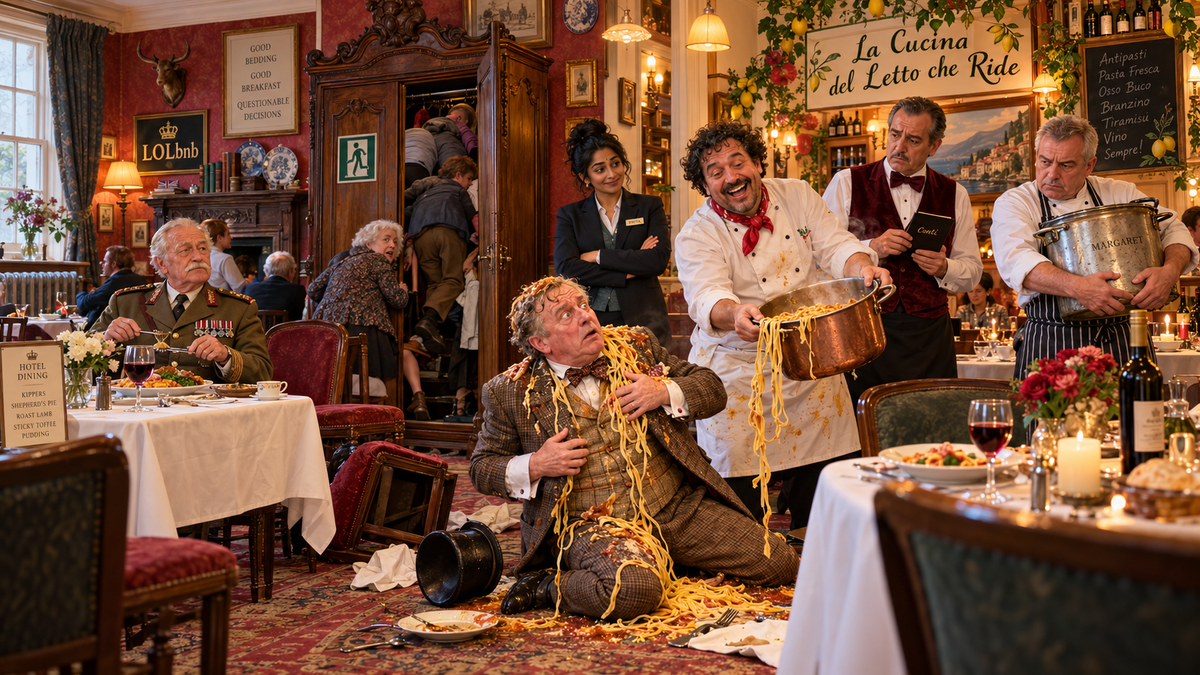
Gerald Ashworth pulled away the dust sheet at nine o'clock on Monday morning. The gold lettering caught the sun with a confidence the rest of the week would not share. LA CUCINA DEL LETTO CHE RIDE, it said, a foot high, over the side door of LOLbnb. "The Kitchen of the Laughing Bed," Gerald announced. "I put LOLbnb into a translation app. Gold leaf. Eleven hundred pounds." Massimo Ferrante, the restaurateur, had come from Bologna by way of four restaurants in three countries, and wore a bow tie of the deepest burgundy. He studied the sign for some time. "In Italian," he said gently, "it sounds like a condition. Something a man sees a doctor about, privately." Priya did not look up from the reception desk. "So for once the signage is accurate."
Massimo's lease covered "the restaurant premises and kitchen." Gerald had written that phrase himself, and by it he meant the dining room in the evenings and some shelf space. Massimo had taken it to mean what it said. Chef Dennis had not read it at all, because nobody had shown it to him. He learned of the arrangement at ten past nine, when he walked into his kitchen and found a young man in whites stacking forty sacks of semolina against the walk-in fridge. This was Lorenzo, the new chef. He had spent six years cooking aboard a Mediterranean cruise ship, and in all that time he had never made anything for fewer than two thousand people. He shook Dennis's hand with both of his. Then he turned to the back of the range, where a vast, dented aluminium stockpot sat murmuring over the lowest flame in the building. "Beautiful old pot, chef. Shall I give her a wash for you?" Dennis got between Lorenzo and the pot with the speed of a goalkeeper. "That's Margaret," he said. "She's been on since 2007. She has never been empty and she has never been washed, and the day she is, I go with her."
By eleven there was a line of yellow tape across the kitchen floor. Gerald had laid it himself, with a spirit level, as a gesture of fairness. The tape gave Lorenzo the six-burner range and the pasta table. It gave Dennis the sink, the fridge and Margaret. This meant neither man could cook a meal without crossing the other's border. They refused to speak directly. Dennis rang reception on the internal phone to ask Lorenzo, who was eight feet away, to stop putting flour into the air. Priya rang the kitchen extension, listened, and rang Dennis back. "He says the air is on his side." Massimo was leaning in the doorway. He took a small black notebook from his jacket and wrote in it. "The tape," he explained to Gerald. "Four euro. I keep a record of what this costs me. It is very calming." Gerald was delighted with how well things were going, and went off to laminate a notice: KITCHEN HARMONY IS EVERYONE'S RESPONSIBILITY.
Massimo's team worked through Monday night, and on Tuesday morning the dining room had a wall in it. The wall was made of Gerald's Victorian wardrobe, the upright piano and a row of upended tables. It ran straight down the middle of the room, giving the Italians the bay window and leaving LOLbnb the half with the radiator that knocks. It also put the fire exit behind the wardrobe. To reach it, a guest now had to open the wardrobe doors, push past Gerald's winter coats and climb out through a hole in the back panel, which Massimo's men had cut with great care and lined with felt. "We are now the only hotel in England where escaping a fire involves Narnia," said Priya. The wall had one further victim. It ran exactly through the middle of table four, where Colonel Rupert Fanshawe had breakfasted every day since 1997. Invited to move, the Colonel declined. "I have held this table through two recessions and a divorce," he said. "I am not ceding half of it to a lasagne." He sat down with his chair in England and his elbow in Italy, and asked for his kippers.
Gerald's publicity, meanwhile, had gone under every bedroom door: TONIGHT, EVERY LOLbnb GUEST DINES ITALIAN! He meant it as an inspiring invitation. Every single guest read it as a description of what they had paid for. By lunchtime there were twenty-two reservations for "the included dinner." Lorenzo had never worked anywhere that dinner wasn't included, and he was overjoyed. He made pasta for three hundred, because his hands did not know how to make less, and by four o'clock the walk-in fridge held a wall of tagliatelle the height of a man. Massimo looked at it for a long while. "Six hundred and ten euro," he said, and wrote it down. Then Gerald came in waving his phone. Philippa Strand, restaurant critic of a Sunday paper, had booked for eight o'clock under a false name. "She dines incognito," Gerald told the assembled staff, in the voice of a man briefing commandos. "So we treat every single diner as though they might be her." He laminated that too. After a short conversation with Massimo about money, he also laminated a smaller notice for the restaurant door: DINNER IS NOT INCLUDED. THIS MEANS YOU.
At seven, Lorenzo stood in the restaurant doorway and welcomed the first diners the way he had welcomed them for six years: "Good evening, passengers, and welcome aboard." The passengers didn't mind, because they had come for the free dinner. Gerald intercepted them one by one at the laminated notice. Those who would pay went left, into Italy. Those who would not went right, into the radiator half of the room. Dennis had announced that he would not make Italian food under any circumstances, but he could hardly let people starve, so on that side he was serving shepherd's pie at cost, with his gravy, which came from Margaret. Within half an hour the British side was full. The Italian side held a retired couple from Harrogate and a vicar who had come in looking for the toilets. Massimo wrote in his notebook. Lorenzo was used to a ship with nine restaurants, and he sent every table in Italy an amuse-bouche, a second amuse-bouche, a complimentary risotto and a message that there was plenty more where that came from.
At five to eight, a tall man in a dark suit came in carrying a clipboard and a torch, and stood in the hall writing things down. Gerald's heart sang. Nobody but a critic would bring a torch to examine his cornicing. He led the man to the bay window, pulled out his chair and told Lorenzo to send everything. The man said he had really only come to have a look round. "Of course you have," said Gerald, winking enormously, and returned to the door. A small woman in a green cardigan was asking whether there was a table for one. Gerald had spent the whole day turning away people trying to get a free dinner, so he asked for her room number. She said she wasn't staying. "Ah," said Gerald, at the volume he reserved for foreigners and the confused. "Then madam will find the free dinner is through there. With the others." And he steered Philippa Strand, whose last review had closed a two-Michelin-star restaurant in Mayfair, to the only empty seat on the British side: the Colonel's half of table four.
In the bay window, the man with the clipboard was receiving his fourth course. Between the burrata and the pappardelle, he asked whether he might see the fire exit. Gerald said there would be time for all that after dessert, and topped up his Barolo. On the other side of the wardrobe, the Colonel was debriefing Ms Strand. He established her name, her opinion of the Liberal Democrats and the fact that she had never served in anything. Satisfied that she posed no threat, he allowed her the salt. Dennis brought her shepherd's pie. She ate it slowly and in silence, wrote in a small notebook for some time, and then asked, without any change of expression, whether there was more gravy. Priya passed Gerald with a tray and murmured that a restaurant critic would probably not wear a lanyard from the county fire service. "I emailed them on Tuesday," she said. "When the wardrobe went up."
In the kitchen, Lorenzo had reached the moment his whole career had prepared him for. Massimo had told him that the gentleman in the bay window was extremely important, so Lorenzo had decided to cook all the pasta at once. Three hundred portions were now boiling in a forty-litre cauldron he had brought from the ship, the way other people bring photographs. The pasta was ready and it had to be drained, but the sink was on Dennis's side of the tape. Dennis stood in front of it with his arms folded. "Chef, please," said Lorenzo. "In two minutes it's soup." "Then it should have been soup from the start," said Dennis. Lorenzo looked at the cauldron, then at the tape. The kitchen had no outside door. Since Tuesday, the only way to the yard drain was through the dining room and the wardrobe. He wrapped the handles in two tablecloths, lifted the cauldron and set off. Behind him the steam rose slowly and gathered round the smoke detector, which had hung there unbothered for eleven years.
The alarm went off just as Lorenzo entered the dining room. Twenty-two guests, a vicar and a fire officer stood up. The Colonel rose to his full height. "Fire exit! Single file! Through the wardrobe!" Nobody at LOLbnb had ever been given a clearer instruction, and everyone obeyed. They filed into the wardrobe, through Gerald's coats and out of the hole in the back panel. Coming the other way was Lorenzo, carrying forty litres of boiling pasta that he could not see over. "Make way for the pasta please, passengers," he called cheerfully. The Colonel ordered a wedge formation. Dennis came out of the kitchen clutching Margaret to his chest like a child rescued from a burning house, and refused to join it. The fire officer stood in the middle of the dining room, writing very fast. Gerald had just worked out which of his guests was the critic, and was on his knees beside table four, apologising.
He had got as far as "Madam, there has been the most terrible—" when the wardrobe gave way. It was being pushed from one side by a queue and from the other by a man with a cauldron, and it fell forward, gracefully, with its doors open. Lorenzo stepped back and kept the cauldron level, but the tablecloths slipped, the lid went with them, and roughly thirty portions of tagliatelle landed on the man kneeling at the critic's feet. The alarm stopped. Gerald knelt there, steaming. Philippa Strand lifted her plate an inch, so that no tagliatelle could fall into her gravy. The Colonel, whose table was whole for the first time since Monday, sat back down at it and finished his kippers. The fire officer stepped carefully over the wardrobe. "Evening, Philippa," he said. "Evening, Clive," said the critic. Massimo opened his notebook in the doorway, considered it, and closed it again. "I think," he said, "we stop counting in euro."
The review would not appear until Sunday. But on Wednesday morning, Ms Strand emailed to book table four for Friday, a party of six: "The pie, please, and as much of the gravy as the chef can spare." Priya read it aloud at reception, and Gerald laminated it. Dennis allowed himself the smallest smile anyone had seen on him since 2007, and he had nearly carried it as far as the kitchen when Lorenzo came through the front door, beaming, with Massimo behind him holding a bunch of flowers. Lorenzo held out a stockpot. It was Margaret, but not as anyone had ever known her. She shone. Every dent had been polished, and you could see the ceiling in her. "A gift, chef, to say sorry," said Lorenzo. "Four hours with wire wool. At the bottom I found a carrot from 2006." Dennis looked at Margaret for a long moment. Then he took her and said, "Thank you, Lorenzo." Lorenzo hugged him, Massimo handed him the flowers, and Dennis stood in the hallway holding a bouquet and a clean pot while everyone waited to see whether he would say anything else. He did not. Priya was already dialling. "Ms Strand? It's LOLbnb, about Friday," she said. "I'm afraid the gravy has suffered a bereavement."