
LOLbnb: WE DO NOT SERVE DINNER
When a Punjabi dhaba opens opposite LOLbnb's Italian restaurant, an argument over who has the right to serve dinner becomes a legal, culinary and deeply personal catastrophe. Colonel Fanshawe is appointed to define dinner. This does not help.
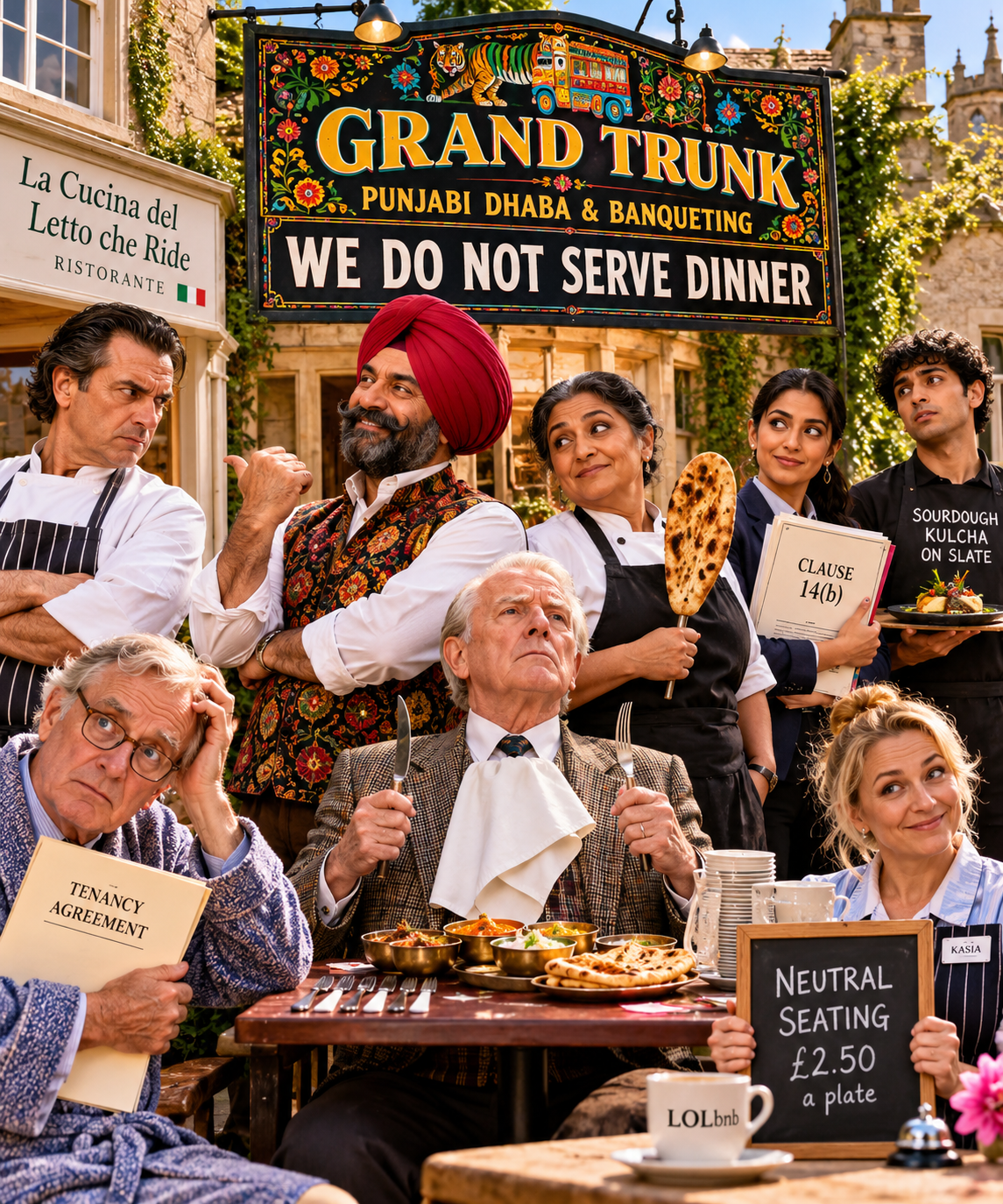
The sign went up on a Tuesday, before breakfast, and at ten past seven Gerald Ashworth was standing beneath it in his dressing gown, reading it aloud to Priya, who had read it at six. It ran three metres along the old orangery on the east side of the house, saffron and green on black, bolted into brickwork that had not been asked to hold anything heavier than wisteria since 1890. THE GRAND TRUNK, it said, and below that, in gold, PUNJABI DHABA & BANQUETING, and below that, in letters exactly as large as the restaurant's name, WE DO NOT SERVE DINNER. "It's a restaurant," said Gerald. "Dinner is the whole point of a restaurant. It's practically the definition." Priya said the definition was rather the problem, and that it was in the licence agreement. Gerald said he had written the licence agreement. Priya said she knew; that was why she had come down. Across the gravel, at the window of La Cucina del Letto che Ride, Massimo Ferrante was photographing the sign with a long lens and great patience, as people photograph a neighbour's car parked across their drive.
The trouble dated from a Thursday in September, when Gerald, wishing to avoid a solicitor's invoice, took Massimo's agreement out of the filing cabinet, crossed out "Italian" in four places, wrote "Punjabi" above each in green ink, and drove to Wolverhampton to negotiate. Gurmeet Singh Sandhu received him in the office above his cash-and-carry and gave him tea, three jalebis and forty minutes on Calor gas prices, the decline of county cricket and the many virtues of Gerald's late father, whom he had never met. Somewhere in those forty minutes Gerald raised the rent twice, and Mr. Singh agreed twice, looking each time as if a dear friend had picked his pocket. Gerald drove home believing he had conducted the negotiation of his career. Mr. Singh had come away with the orangery, eleven parking spaces on Saturdays, two shelves of the walk-in freezer and the service charge waived "in the first instance," a phrase Gerald added himself because it sounded prudent. He had been Mr. Singh to English landlords since 1979, because it saved time, and Mr. Sandhu to his bank, because it saved money. His daughter Simran read the agreement on the train home and found Massimo's original stapled to the back "for reference," including clause 14(b), which gave La Cucina "the exclusive right to provide dinner service within the Property," and 14(c), which entitled the holder to the lost revenue of every cover served in breach of it. She found something else on page nine of their own copy and decided her father did not need to know about it yet. That same afternoon Gerald renewed the coffee shop's licence. He used the same form, because he had it open.
Within a fortnight the orangery had become a place people photographed before they sat down. A cousin from Southall had painted the panels in the manner of the lorries on the Grand Trunk Road: parrots, mountains, a tiger with a very knowing expression and, at Priya's insistence, nothing that could be mistaken for a fire exit. The charpoys had been restrung with fire-retardant webbing from a firm in Leicester, the marigolds were silk because the insurers had asked, and the music was Gurdas Maan at a volume agreed with Priya to the decibel and then exceeded by the margin Mr. Singh considered hospitable. Behind glass, the tandoor belonged to his wife Jaswinder, who had run kitchens for weddings of nine hundred and regarded sixty covers as a sit-down. The menu had no mains. It had Light Bites, Snacks and Something for the Road, and the Light Bites included a leg of lamb marinated for thirty hours, "for the table," the table being one of six. Their son Bobby, who had a degree in hospitality management, wanted to call the charpoys "communal daybeds," serve sourdough kulcha on slate, and print the menu without prices so that guests would feel trusted. His father said it was a lovely feeling and would last until the bill. "In this country," Mr. Singh told the first night's guests, "a man pays twenty-eight pounds to hear a story about a tomato. Here he pays nineteen and somebody drives him home."
Massimo came to Gerald's office with both agreements and a yellow highlighter. "Fourteen b," he said. "Exclusive right to dinner service." "A beautiful clause," said Mr. Singh, who had arrived two minutes later with a box of pinnis for Priya. "And your food is beautiful, Massimo-ji. My wife studied your menu for a long time. She said she has never seen a kitchen so confident with empty space." Massimo thanked him. In Italy, he said, there was a saying that a cook who gives you too much is hoping you will not taste it, but naturally Mr. Singh's portions were a gift to the community, and he had seen a guest carried to the car park. "Walked," said Mr. Singh. "With assistance. That is service." Gerald said that, as the proprietor, he would like to establish the facts. Massimo established clause one: dinner meant the principal meal of the evening. "Principal for whom?" said Mr. Singh. "For the guest." "Then ask the guest. No Englishman has ever admitted to his principal meal. He had a bit of something." "A man who has eaten your bit of something cannot eat anything else. So it is principal." "And a man who has had Dennis's brunch at half past two cannot eat your ravioli, so Dennis serves dinner at lunchtime and you must take it up with him." Gerald decided that what was needed was an independent definition from someone of standing who had eaten in neither restaurant, which meant Colonel Fanshawe, who took a Bovril and two cream crackers in his room at six. Massimo agreed, assuming the Colonel would find a dhaba informal. Mr. Singh agreed, having heard the Colonel call modern portions an insult to the working man, and offered to supply the Colonel's Bovril for the duration of the inquiry. "That is a bribe," said Massimo. "It is Bovril," said Mr. Singh. "You've appointed a judge," said Priya, "because he's never tasted the evidence." "Precisely," said Gerald.
The Colonel took the commission more seriously than anyone had taken anything at LOLbnb since the fire inspection. He returned the jar of Bovril unopened, with a note, requisitioned the residents' lounge, interviewed Dennis, Lorenzo, a delivery driver and a retired couple from Harrogate named Pargeter, and kept his notes in a ledger he labelled MEAL. He asked for his appointment in writing, and Gerald, delighted to be asked for anything in writing, produced it on headed paper with the words "acting on behalf of the management." Priya photocopied it and filed the copy under 14(d). Gerald asked whether there would be a right of appeal. "A definition one can appeal is an opinion," said the Colonel. Gerald asked whether it should be stamped. The Colonel said he had brought his own. On Friday morning he read the ruling to both parties, who were made to stand. "Dinner is a meal taken after six o'clock in the evening, seated at a table, at which more than one knife is laid, and at which a gentleman would be expected to wear a jacket. A meal failing any of these tests is supper, a snack or a disgrace, and I decline to say which." Gerald, glowing, mentioned that his family had always taken Christmas dinner at two o'clock. "Then it was lunch, Gerald," said the Colonel, "and you have been misdescribing it for fifty years." He rolled up the leather cutlery case he had carried to every meal since a hotel in Aldershot gave him a blunt knife in 1974, and Gerald, slightly subdued, stapled the ruling to every agreement in the current series as Schedule 3. "Thank you, Colonel," said Massimo. "Thank you, Colonel," said Mr. Singh. Both of them were already working out where the fence was lowest.
By six that evening the Grand Trunk had no knives. The roti, Mr. Singh explained to a family from Kettering, was the knife, and also the spoon, and in a sense the plate. The tables went into storage, guests sat on charpoys with brass trays across their knees, and the only table left in the room was the family's own, by the kitchen door, where the Sandhus ate at four and Simran did the accounts. Bobby stood at the entrance taking jackets in exchange for numbered brass tokens, "complimentary jacket care," and returned them steamed, which brought several guests back purely for the steaming. Massimo laid four knives at every place, including a fish knife on a menu with no fish, made jackets compulsory, and borrowed for the purpose the hotel's lost-property rail, which Priya had kept in date order since 2014 and which contained eleven blazers left behind at weddings. Hire was five pounds, refundable against dessert, so that a guest could pay Massimo to put a jacket on, have Bobby take it off him for nothing, and walk between the two all evening in his shirt. A Dutch cyclist of six foot five ate his tagliolini in the blazer of a wedding guest of about five foot eight, elbows clamped to his ribs, raising each forkful as though it might go off. A sales manager from Slough, whose company paid unlimited snacks but capped dinner at thirty pounds, ate forty-four pounds of light bites at the Grand Trunk, crossed the gravel for tiramisu in a borrowed jacket, and came to reception asking Priya which receipt was dinner, because if it was the tiramisu he would have to pay for the lamb himself. Mrs. Pargeter, who could not bear either man to feel slighted, booked the restaurants on alternate nights and tipped both twenty per cent, then discovered that each proprietor knew to the penny what she had tipped the other.
The staff were reading the situation in their own way. Lorenzo, who had spent six years feeding Mediterranean cruise passengers by the thousand and considered Jaswinder the first person at LOLbnb to understand quantity, went over at four "for ten minutes" and came back at ten to seven floured to the elbows, having learned to slap naan against the tandoor wall and taught her his method for banqueting risotto. The next day he baked rosemary focaccia in the tandoor and carried it into La Cucina in triumph. Massimo asked whether he understood that he had been in the enemy's oven. Lorenzo said it was a wonderful oven and Massimo should try it. Massimo said that was exactly the problem, tore off a corner, ate it standing by the pass, ate a second corner, and put it on the menu at four pounds fifty. In the coffee shop, Kasia noticed that guests who did not wish to be seen choosing had begun carrying takeaway from both restaurants to her tables, and introduced a seating charge of two pounds fifty a plate, a laminated sign reading NEUTRAL SEATING, and proper cutlery, two knives a setting, from a wholesaler Simran recommended. Dennis said nothing for a week. Then at five one morning he stood at the Grand Trunk's back door and watched Jaswinder fold ghee into paratha dough, turn it and fold it again, and went back to his kitchen without a word. On Sunday aloo paratha appeared on the brunch menu, "by arrangement," Jaswinder supplying the dough at seventy pence a piece, and brunch began running until half past three. To the Colonel, the one man whose palate he respected, Dennis said it was the best laminated dough he had seen outside Lyon.
The Sandhus held their meetings at the pass after midnight, so that Jaswinder could attend without stopping work. "From tomorrow," said Mr. Singh, "the dal cooks overnight." "It has cooked overnight since we opened," said Jaswinder, scraping the tandoor. "Then the menu will say so." "It says so," said Simran. "You wrote it." "Then I was right." Bobby, who had been seen having coffee with Massimo, proposed a tasting menu of seven Punjabi small plates, each with a story. His father asked whether the stories would be filling. Jaswinder said seven plates a guest at sixty covers was four hundred and twenty plates, and asked Bobby which of them he would be washing. Mr. Singh's own plan was complimentary kulfi for every table at La Cucina at half past nine, so that Massimo's guests finished their evenings in Punjab. Simran said that would be the Grand Trunk serving food in Massimo's dining room, after six, at a table, with knives. "Kulfi is eaten with a spoon." "He lays four knives, Papa. He'd put them under the kulfi." Jaswinder mentioned that the kulfi moulds were in the Wolverhampton freezer and the van was in Walsall with Bobby's cousin, who was not answering, and the plan was abandoned on strategic grounds. Simran reminded her father that the Colonel was now the most dangerous customer in the building and that if he ever ate at the Grand Trunk it would be evidence. Mr. Singh laughed and said the Colonel would never eat there, because the Colonel ate Bovril. "Thursday, twenty past seven," said Jaswinder. "Dennis asked. I said yes. He needs a chair. His knees."
The Colonel came on Thursday at twenty past seven, in his jacket. Bobby stepped forward with a brass token. "I have worn this jacket to my evening meal since 1971," said the Colonel. "It isn't dinner, sir," said Bobby. "Then there can be no objection to my keeping it on. In any case, I am here on behalf of the management." The only chair in the room belonged to the family table, so Jaswinder seated him there, by the kitchen door, before her husband had finished crossing the room. The Colonel unrolled his leather case and laid out a fork, a spoon and three knives, and Bobby, who had been taught never to touch a guest's belongings, left them where they were. He ate the paratha with knife and fork, then the saag, the dal and a portion of lamb Jaswinder described as modest, slowly and without speaking, and at the end said it was the best meal he had eaten since his mother died, and she had not been a good cook. He insisted on paying, thirty-one pounds fifty, and left a tip in coins sorted by denomination. From the gravel, through the orangery glass, Massimo saw the jacket, the table, the clock above the tandoor and the three knives in a row, and went for his camera.
"Seven forty-one," said Massimo the next morning, laying the photograph on Gerald's desk. "Seated. Table. Three knives. Jacket. Schedule three. The Grand Trunk has served dinner, and under fourteen c I am owed my lost revenue for the cover." Mr. Singh said the Colonel had sat at the family table, a man at your family table is family, and nobody serves dinner to family; they feed them. "Did family pay?" said Massimo. Simran looked at her tablet. "Thirty-one fifty, plus tip," she said, and her father looked at her as though she had sold the house. The Colonel was sent for and confirmed it with appalling honesty. "It was dinner, Gerald. I wrote the rules. I should know one when I've eaten it." Simran, who had hoped to keep page nine for a better occasion, turned to it anyway. Gerald had crossed out "Italian" four times in the Grand Trunk's agreement and left clause 14(b) exactly where it was. The Grand Trunk also held the exclusive right to dinner service within the Property, and since it opened La Cucina had served four hundred and twelve covers, seated after six, with four knives and a jacket, each one in breach. "I'm sure I took that out," said Gerald. "You crossed out the word Italian," said Priya. "You didn't cross out the word exclusive. It doesn't have a nationality."
Massimo, who could count, saw that he was one breach to the good and four hundred and eleven to the bad, and spent some time studying the ceiling. Mr. Singh grew expansive. Between neighbours, he said, what were four hundred and twelve dinners? He would waive the lot on two small conditions: that Massimo withdraw his claim against the Grand Trunk, and that Lorenzo continue his Tuesday afternoons at the tandoor, "for the exchange of recipes, which Massimo-ji has always encouraged." Lorenzo, listening from the corridor, called out that he had always encouraged it too. Massimo withdrew his claim against the Grand Trunk. Against the landlord, he said, he had not yet made one. He read aloud clause 14(d), under which a breach occasioned by a person acting on the landlord's authority was the landlord's to indemnify, and Priya, without looking up, took the photocopy out of the 14(d) file and slid it across the desk. Gerald therefore owed La Cucina the lost revenue of one cover, which Massimo assessed at the tasting menu with matched wines, ninety-six pounds, adding that the Colonel would have enjoyed the veal and that it was a great pity he had eaten the lamb instead, because Massimo had seen the lamb and it was very good. Gerald wrote the cheque with enormous satisfaction. "It establishes that I am the landlord," he said, blotting it. "Nobody can say I haven't been even-handed." Nobody could, and Priya filed the stub.
On Sunday Gerald conducted what he called exit interviews in the hall, and Massimo and Mr. Singh happened to be passing at checkout, one by the umbrella stand and one by the leaflets. Asked which restaurant she had enjoyed most, Mrs. Pargeter looked from one man to the other and said, after a dreadful pause, that their nicest evening had been in the coffee shop, where they had taken a little from each so that nobody's feelings would be hurt, and the girl had laid them two knives each, and Geoffrey had kept his jacket on because he always does. Kasia came out from behind the counter and handed Gerald an envelope. Inside was the coffee shop licence he had renewed in September on the same form, with clause 14(b) intact and Schedule 3 stapled to the back, as on every agreement in the current series. By the Colonel's definition the Pargeters had dined, at her tables, which made the coffee shop a dinner service, and every cover served across the gravel since September a breach of her exclusive right; Simran, who had kindly looked it over, put the figure at a little under nine hundred covers, and pointed out that nothing Massimo and her father had agreed between themselves had anything to do with Kasia. Mr. Singh turned to his daughter. Simran was reading a leaflet about the cathedral. The Colonel, who had come down to see the Pargeters off, said quietly that the young lady was correct, and that with three establishments now holding the exclusive right to dinner, any dinner he ate on the property would breach two of them on behalf of the management. At a quarter past seven that evening he stood at Kasia's counter in his shirtsleeves, jacket folded over his arm, eating Jaswinder's dal from a paper tray with a single plastic knife, while the Pargeters, whose taxi was late, sat in neutral seating trying not to look. "Enjoy your snack, Colonel," Mrs. Pargeter called, as kindly as she could. "Supper, madam," said the Colonel, without turning round, and Kasia charged him the two pounds fifty anyway, on the grounds that he was leaning.