LOLbnb: The Great Sunday Brunch Disaster
Sunday brunch at LOLbnb was supposed to be a relaxed affair. Then came a colonel commanding the buffet, ladies fighting over a table, a runaway waffle machine, a missing platter and a ring served with whipped cream. By noon, the guests were delighted.
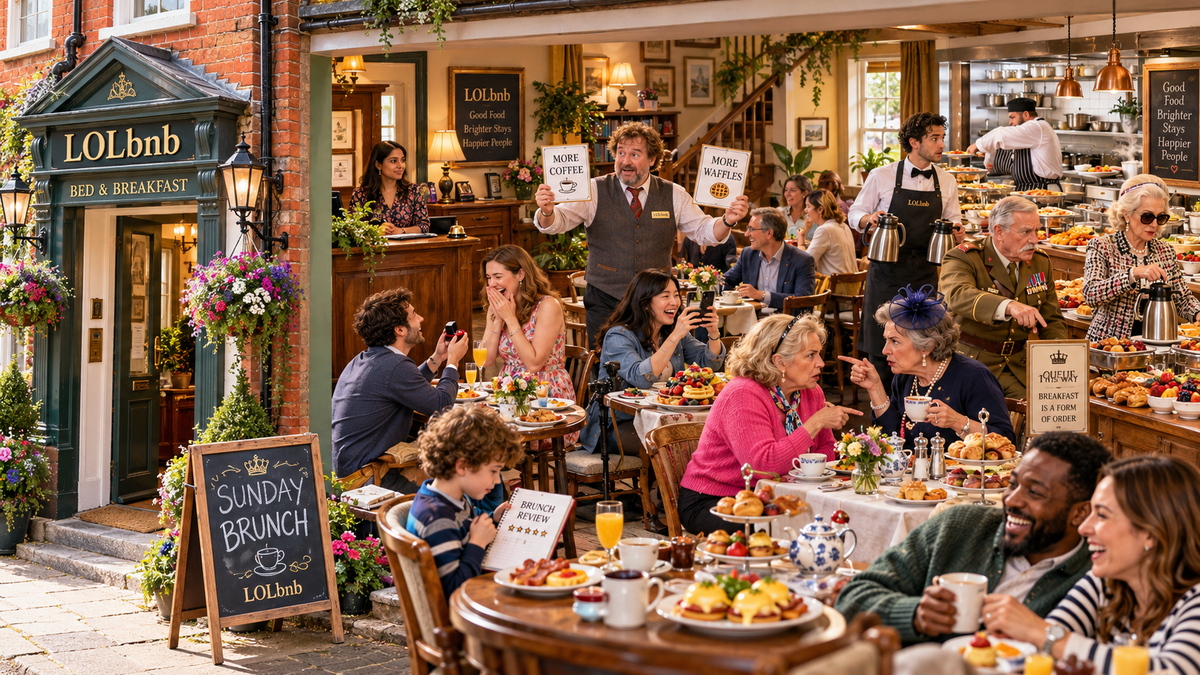
By nine o'clock on Sunday morning, Gerald Ashworth had laminated four new signs, and he believed this was the same thing as being prepared. The red-brick front of LOLbnb looked superb: hanging baskets watered, brass knocker polished, a chalkboard on the pavement announcing SUNDAY BRUNCH — ALL WELCOME — £18.50. Inside, Chef Dennis had been up since five, making hollandaise with the stillness of a man defusing something, and the dining room smelled of butter, bacon and a small fortune about to be made. "Community," Gerald told Priya at reception, tapping his newest sign, which read PLEASE QUEUE THIS WAY above a confident arrow. "Revenue. Reputation." Priya looked at the arrow. "Gerald, that points into the kitchen." "It points towards the food." "It points towards Dennis." Gerald considered relaminating, but it was ten o'clock, the doors were open, and the British public was coming up the garden path in the slow, determined formation it adopts whenever something is nearly free.
Colonel Rupert Fanshawe, retired in no way anyone could detect, arrived first and therefore regarded the buffet as his to command. Within four minutes, eleven people had followed Gerald's arrow and were standing politely beside Dennis's fryer, holding empty plates and apologising to him for being there. The Colonel extracted them, divided the line into a hot flank and a cold flank, and posted Walter, the waiter, at the junction. Mrs Dobbs, who has lived in Room 4 for nine years and joins every queue on principle, asked whether this was the queue for the eggs. "This is the queue for the queue, madam," said the Colonel. "Eggs are phase two." Behind them, seven-year-old Oliver Hargreaves, youngest of a family of six, licked his pencil and wrote in a small notebook: Queue. Confusing. Three stars.
Mrs Celestine Vane arrived in pearls, cashmere and a cloud of something expensive, and asked Walter for the bottomless brunch. Walter explained that LOLbnb was alcohol-free. "Then I shall be bottomless in principle," she said, and pointed to the menu, which promised unlimited refills of tea and coffee. From her handbag she produced a tartan vacuum flask. "Fill her up, darling." Walter, who takes every instruction literally and with total devotion, filled it. She produced a second. Priya, passing with a tray of marmalade, paused. "Is that within the spirit of the refill?" "It's within the letter, Priya," said Walter, and went back for more coffee, because Mrs Vane had produced a third flask, smaller, "for the car."
Table seven sits in the bay window, overlooking the rose garden, and it has the best light in the county. Mrs Margaret Thorne and Mrs Beverley Pike reached it at precisely the same moment, and each placed her handbag on it, which in that part of England counts as a declaration of war. They had been at war for fifteen years, ever since the 2011 church fete, when both of them brought the trifle. Jasper Quill, a food influencer, also wanted table seven, because of the light, and he was already photographing the Hargreaves' scrambled eggs without asking. The Colonel claimed it as strategically vital. Gerald, inspired, produced his fifth laminated sign, RESERVED, and gave the table to Tom and Imogen, a young couple who had not asked for it and only wanted toast. This united all three factions in a quiet, shared loathing of two people who had done nothing at all, except that Tom kept patting his jacket pocket.
Tom was nervous, and Imogen had noticed. "Are you all right? You've gone the colour of the hollandaise." "I'm fine. I've been meaning to ask you something for a very long time." Walter appeared at his elbow. "Black pudding?" "No!" said Tom, too loudly. Imogen put her fork down. "You've been meaning to ask me about black pudding for a very long time?" Tom excused himself, found Walter by the coffee station, and pressed a small velvet box into his hand. "With her waffle," he whispered. "Under the cream. Table seven." "Table seven," said Walter. "Understood." In the corner, Mr Ellison, who comes every Sunday, eats one triangle of toast and somehow knows the inner life of every household within three miles, lowered his newspaper an inch. "Mm," he said.
At 10:52 the waffle machine, a Belgian contraption Gerald had bought second-hand from a man in a lay-by, began to beep, refused to open, and then started releasing waffles every forty seconds, unprompted, like a printer with a grudge. The waffle station had been the one orderly zone in the building. Mrs Thorne had been next when it seized. Mrs Pike, directly behind her, received the first waffle it released. "That waffle," said Mrs Thorne, "was mine by queue." "It was mine by waffle," said Mrs Pike. Dennis wrestled the machine with an oven glove. The Colonel told everyone to stand back, because he had seen this before. "Where?" asked Priya. "Aden, 1967. Different machine." To keep the peace, Gerald quietly moved the Hargreaves family to table seven and Tom and Imogen to the small table by the radiator. Nobody told Walter.
In the kitchen, Gerald held up a waffle so burnt it rang when tapped. "Dennis, we'll have to let the waffle go." Mrs Dobbs, at the serving hatch for more toast, heard it as "We'll have to let Walter go." She told Mrs Pike, since gossip is exempt from all wars. Mrs Pike told Mrs Hargreaves. By table nine, Walter was being dismissed for financial irregularities. By the window, the entire hotel was being sold to a footballer. Somebody asked Mr Ellison whether it was true. "Mm," said Mr Ellison, and this was universally accepted as confirmation. A petition began on a paper napkin: SAVE WALTER. It travelled from table to table, gathering signatures and a little hollandaise. When it reached the coffee station, Walter read it carefully and signed it himself. "Seems only fair," he said.
Then the smoked salmon vanished. One moment it lay on the cold flank in pink, glistening rows; the next there was only a bare platter and a sprig of dill. The Colonel launched an inquiry. Oliver was the obvious suspect, being sticky, but he had an alibi: he had been inspecting the jam (Strawberry. Too good. Suspicious. Five stars.). Mrs Vane was cleared because the salmon would not fit in a flask. It was finally found in the rose garden, arranged on the sundial for what Jasper called golden-hour content, alongside a teacup, a single rose and the Colonel's reading glasses, borrowed "for texture". "I was going to bring it back," said Jasper. "It's been photographed, man," said the Colonel. "Nobody wants it now." "I do," said Mrs Vane, the self-appointed most refined person in the building, who stepped forward and began eating it off the sundial. She lifted a slice and checked the shadow beneath it. "Quarter past eleven," she announced. "And delicious."
At table seven, Oliver Hargreaves cut into his waffle with professional suspicion, met resistance, and extracted a small velvet box from beneath the cream. He opened it, consulted his notebook, and announced to the entire dining room: "This waffle has a ring in it. Four stars. It would be five, but you can't eat it." The room went silent. By the radiator, Tom stood up. "That's — that's mine." "It was in my waffle," said Oliver. Imogen stared at Tom. "Were you going to propose to me through a waffle?" "Through your waffle," said Tom. "It's his waffle now." Mr Hargreaves pulled out a chair. "Do it here, mate. We'll budge up." All six Hargreaves budged up, and Tom went down on one knee at table seven, surrounded by strangers and syrup, while Oliver held out the ring like a magistrate returning lost property. Imogen said yes. The room erupted. Mrs Thorne and Mrs Pike laughed so hard they had to hold on to each other, then realised what they were doing, and let go at exactly the same moment.
In the quiet afterwards, Gerald found Walter folding the napkin petition and tucking it carefully into his breast pocket. "You do know I'm not letting you go," said Gerald. "I know," said Walter. "But forty-three people signed it. You don't get that many at a funeral." He patted the pocket once and went off to refill Mrs Vane's fourth flask. The Colonel solved the waffle machine by unplugging it. "I tried that," said Dennis. "You didn't commit," said the Colonel. Revenue was up. Jasper's video had eighty thousand views by noon. Mr Ellison paid, folded his newspaper and paused at reception. "Congratulations on the sale," he told Gerald. "What sale?" said Gerald. "Mm," said Mr Ellison, and left.
That left one scone on a plate between Mrs Thorne and Mrs Pike, who were now, unaccountably, sharing a table. "Do have it," said Mrs Thorne. "I couldn't," said Mrs Pike. "Nor could I." "Then it'll go to waste." "Then you have it." "I've already said I couldn't, Margaret. I'm not a liar." Gerald, trying to help, cut the scone in half. "Whoever cuts mustn't choose," said Mrs Pike. "I'm not choosing," said Gerald. "I don't want it." "Then why did you cut it?" said Mrs Thorne. "To be fair!" "Cutting a scone you don't want isn't fairness, Gerald. It's interference." Mrs Pike studied the halves. "If I take the smaller one, I'm making a point. If I take the larger one, I'm making a different point." "There is no half you can take," said Mrs Thorne, "that isn't a point." Oliver leaned across, ate both halves, and wrote: Scone. Too much talking. One star. At reception the telephone rang, and Priya answered it. "Next Sunday? Of course, Colonel. Party of how many?" She listened, and her pen stopped moving. "Forty. And they've all seen the video." Across the hall, the laminator began to warm up.