BOZO 7: The Dinner That Had No Agenda

There are dinners to celebrate success.
There are dinners to fix failure.
And then there are BOZO dinners, which happen for a far more complicated reason.
They happen because everyone showed up again.
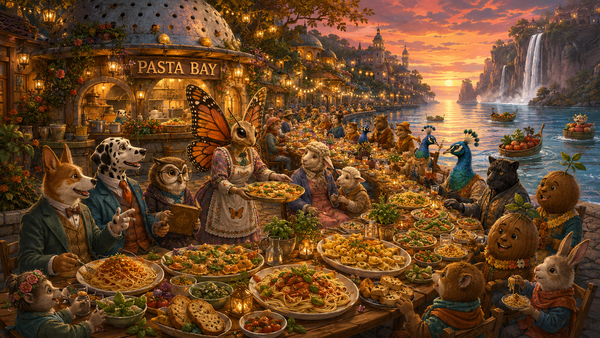
At 8:07 p.m., a table at a modest restaurant was occupied by a company that did not fully understand itself but had begun, quietly, to accept it.
The restaurant was not fancy. It did not try to impress. It had steady lighting, honest chairs, and a menu that did not argue with anyone. It was the kind of place where conversations arrived before the food and stayed after it.
Mr. B.L. Ozo arrived first.
This was becoming a pattern, but tonight it felt different. He was not carrying files. He was not holding a sheet with steps. He was holding… nothing. His hands were free, and for a moment, he did not know where to keep them.
He sat down and looked at the empty chairs.
There was no pressure here.
No arrows.
No timelines.
Just chairs.
Captain Bartholomew Crank arrived next, slightly early in spirit but slightly late in time.
“Ah,” he said, looking around, “neutral territory.”
Mr. Ozo smiled. “No vessels,” he replied.
“No destinations,” added the captain, approvingly.
They sat in a silence that was not uncomfortable. Just unfamiliar.
The staff arrived in waves.
The man with two pens came with one pen. This was a decision.
The tea man came without tea, which caused mild concern until he discovered water.
The rope inspector came with no rope, which made him lighter in a way he could not explain.
They sat down, not in hierarchy, not in formation, but in the quiet randomness of people who had not been instructed.
Menus were opened.
This was a new kind of document. It did not require checking labels or matching destinations. It simply offered options, and for BOZO, options were both exciting and mildly destabilising.
“What are you having?” asked one.
“Let us not rush,” said another, automatically, then paused and smiled at himself.
The waiter stood patiently, a professional observer of human indecision.
“Take your time,” he said, which at BOZO was both a comfort and a risk.
Orders were placed. Not efficiently, not collectively, but honestly.
Food arrived.
It did not need approval.
It did not need a system.
It simply arrived and stayed.
For a while, there was only eating.
No strategies.
No corrections.
No quiet panic hiding behind polite words.
Just the sound of plates, small conversations, and the gentle surprise that this was… enough.
Mr. Ozo leaned back slightly.
“This is good,” he said.
No one rushed to agree. They simply continued, which was agreement of a better kind.
Captain Crank looked around the table.
“We are… assembled,” he observed.
The man with one pen nodded. “Without agenda.”
This was a powerful phrase. It sat at the table like an honoured guest.
Someone laughed.
Not loudly. Not to impress. Just a small, real laugh that did not need to be explained.
The tea man discovered dessert early. This was noted but not questioned.
Conversations drifted.
Not about cargo.
Not about ports.
But about small things that had been waiting.
Someone spoke about a long commute.
Another about a childhood memory of trains that always arrived on time.
Someone mentioned a favourite meal from years ago, described with detail that made the table listen.
Mr. Ozo spoke less.
He listened.
This was new.
Captain Crank told a story that began with the sea and ended somewhere entirely different. It did not need direction. It had presence.
The staff responded not with analysis, but with attention.
And slowly, without announcement, something shifted.
They were no longer roles.
Not MD.
Not captain.
Not staff.
Just people who had spent enough days together to recognise each other without needing explanation.
Sheru arrived.
He did not rush. He did not interrupt. He simply took a seat at the edge of the table.
Suspenders steady. Eyes calm.
The waiter paused for a moment, then continued. Some presences do not require adjustment.
No one made a big moment of it.
They simply made space.
A plate was placed.
Food was shared.
No one asked if it was in the system.
Sheru ate.
Not as a symbol. Not as a supervisor.
Just as part of the table.
At one point, Mr. Ozo looked at him and smiled. Not with relief. Not with dependence. Just with recognition.
“You came,” he said.
Sheru nodded once.
This was enough.
Time moved.
Not measured. Not scheduled. Just experienced.
Plates emptied. Glasses softened. Conversations settled into a comfortable quiet that did not need to be filled.
No one checked the time.
No one mentioned tomorrow.
For a few hours, BOZO Shipping & Logistics was not a company trying to improve.
It was a group that had, for once, stopped trying.
And in that pause, something quietly important happened.
They existed.
Not perfectly.
Not efficiently.
But together.
At BOZO, this was not a break from work.
This was the reason work had begun to make sense.
And when they stood up to leave, there was no announcement, no summary, no conclusion.
Just a shared understanding.
Tomorrow would come.
The system would wait.
The crates would arrive.
But tonight had done something the system could not.
It had held them, without asking them to perform.
And that, in its own quiet way, was the most organised moment BOZO had ever had.