BOZO 3: The Meeting That Achieved Everything Except a Decision
There are meetings that shape industries. There are meetings that clarify strategy. And then there are BOZO meetings, which begin with purpose, expand into philosophy, pause for snacks, and conclude with a deep sense of participation.
At precisely 10:03, the Conference Room of BOZO Shipping & Logistics was declared active.
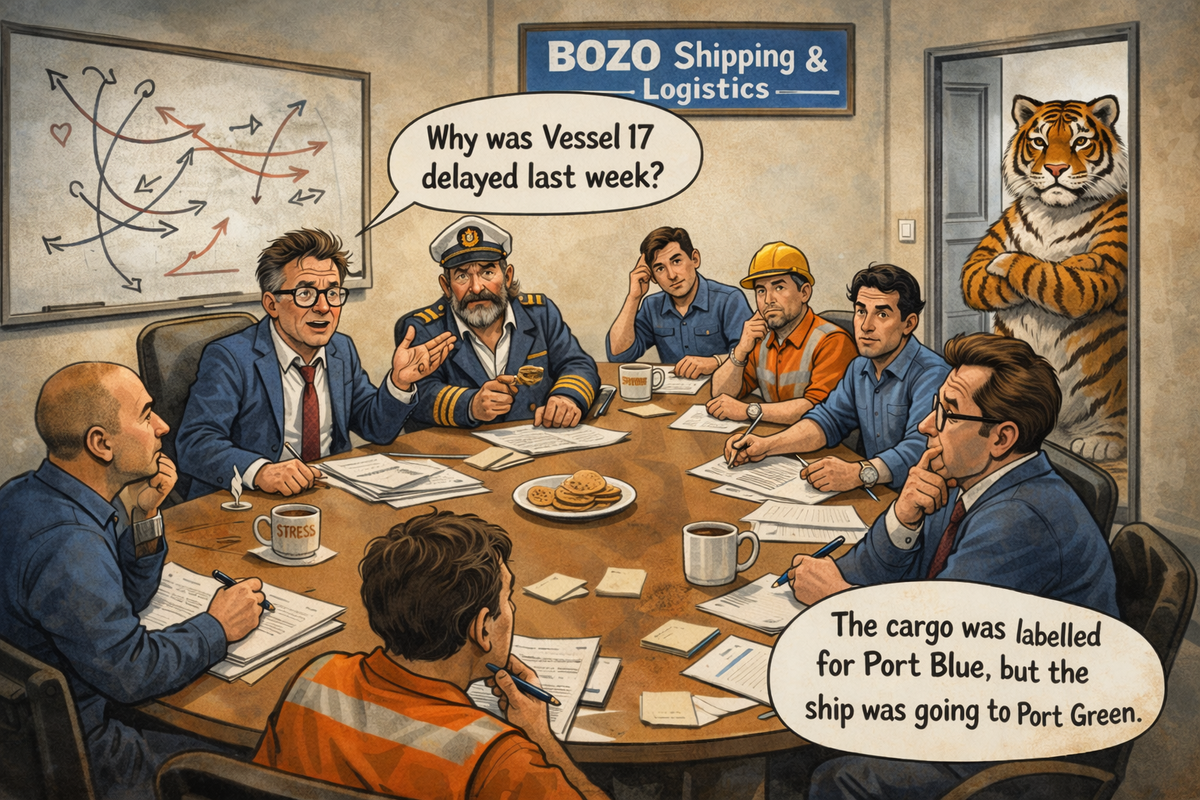
The table was long. The chairs were uneven in confidence. The whiteboard had been wiped recently, but not completely, leaving behind faint ghosts of arrows from previous ambitions. A marker lay on the table, uncapped, drying slowly like an idea that had been left unattended.
Mr. B.L. Ozo entered first, carrying three files, two worries, and one fragile intention to “streamline operations.”
“Let us begin,” he said, with the firmness of a man who hoped the beginning would not resist him.
The staff gathered in layers.
Some arrived with notebooks. Some arrived with expressions. One arrived with a cup of tea so thoughtfully prepared it seemed unlikely he would contribute anything else for the next forty minutes. The man who wrote notes yesterday had brought two pens today, a sign of either growth or precaution.
Captain Bartholomew Crank entered last, which he believed was leadership. He paused at the door, surveyed the room like a general entering a battlefield he did not fully recognise, and took his seat with a soft adjustment that took longer than necessary.
“We are here,” said Mr. Ozo, “to improve efficiency.”
There was a respectful silence, the kind that politely avoids the subject.
Mr. Ozo stood up and approached the whiteboard. He drew a line. Then another. Soon there were arrows. The arrows had direction. The arrows had ambition. The arrows had absolutely no connection to any known workflow, but they looked convincing, and that was a start.
“This,” he said, pointing to a cluster of arrows that appeared to be negotiating with each other, “is our process.”
Captain Crank leaned forward. “It looks like movement,” he observed.
“Yes,” said Mr. Ozo, relieved. “Exactly.”
Encouraged by this early agreement, the room began to participate.
One man suggested that delays were due to “external factors,” which was widely accepted because external factors had never attended a meeting to defend themselves.
Another proposed that communication needed to be “more proactive,” a phrase that entered the room confidently and sat down without explanation.
The tea man nodded thoughtfully at both points, taking small sips that suggested deep internal alignment.
Then came the question.
“What exactly,” asked the man with two pens, “is the problem we are solving?”
The room paused. This was a strong question. A dangerous question. A question that required clarity, which had not been scheduled.
Mr. Ozo looked at the arrows. The arrows offered no assistance.
Captain Crank cleared his throat. “The problem,” he said, “is that sometimes things do not happen as they are meant to happen.”
This was received as wisdom.
There were nods. Slow, meaningful nods. The kind of nods that forgive the absence of specifics.
“Correct,” said Mr. Ozo quickly, capturing momentum. “So how do we ensure that things happen… as they are meant to happen?”
This opened the floor to solutions.
“Better timing,” said someone.
“Clearer roles,” said another.
“More coordination,” added a third, confidently.
These were excellent words. They sat well together. They created an atmosphere of progress. No one felt the need to connect them to actions.
At this point, the meeting reached its natural midpoint: biscuits.
A plate appeared, as it always did, as if the building itself understood that intellectual exertion required circular nourishment. The biscuits were accepted with gratitude. Discussions softened. Ideas became more philosophical.
“Efficiency,” said Captain Crank, holding a biscuit as though it were a compass, “is not just about speed. It is about… alignment.”
“With what?” asked the man with two pens.
“With… direction,” said the captain, satisfied.
The tiger entered the room.
Mr. Sheru did not sit. He did not speak. He stood near the door, observing.
The effect was immediate.
Postures adjusted. Pens became purposeful. The word “alignment” quietly exited the room.
Mr. Ozo turned, saw Sheru, and for a brief moment, remembered what meetings were supposed to do.
“Let us be specific,” he said, with a sudden clarity that surprised even him. “Why was Vessel 17 delayed last week?”
The room shifted.
Eyes moved. Papers were rearranged. One man looked at the ceiling as if answers might be stored there.
Finally, the note writer spoke.
“The cargo was labelled for Port Blue,” he said carefully, “but the ship was going to Port Green.”
Sheru blinked once.
“And why,” asked Mr. Ozo, “did that happen?”
Silence again, but this time it was honest.
Because no one checked.
Because everyone assumed.
Because the crate had been studied, admired, respected, but not verified.
These truths did not arrive dramatically. They arrived quietly, like guests who had always been invited but rarely acknowledged.
Mr. Ozo nodded slowly.
“So,” he said, “we check.”
It was not revolutionary. It was not complex. It was not surrounded by arrows.
But it was real.
“We check the label against the destination,” he continued. “Before loading.”
The room absorbed this. It was simple. It was doable. It was… uncomfortable in its clarity.
Captain Crank nodded. “A direct approach,” he said, approvingly.
The man with two pens wrote it down. This time, he underlined it.
Sheru turned and walked out.
The meeting continued for another twenty minutes, because meetings at BOZO respected tradition. There were a few more suggestions, a brief return to general philosophy, and one last biscuit that no one wanted but someone took anyway.
At 11:12, Mr. Ozo closed the file.
“So we are agreed,” he said.
Everyone agreed.
Not loudly. Not dramatically. But with the quiet understanding that something small and important had been decided.
As they left the room, there was a subtle shift in the air. Not a transformation. Not a breakthrough. But a slight movement toward sense.
At BOZO Shipping & Logistics, the meeting had not solved everything.
It had done something far more unusual.
It had solved one thing.
And for this organisation, that was progress of the highest order.