Board Games at ZANABIA
As evening settled across ZANABIA, the tables were folded away, the scoreboards were dismantled, and nobody could accurately explain who had won, who had lost, or whether any actual games had taken place.
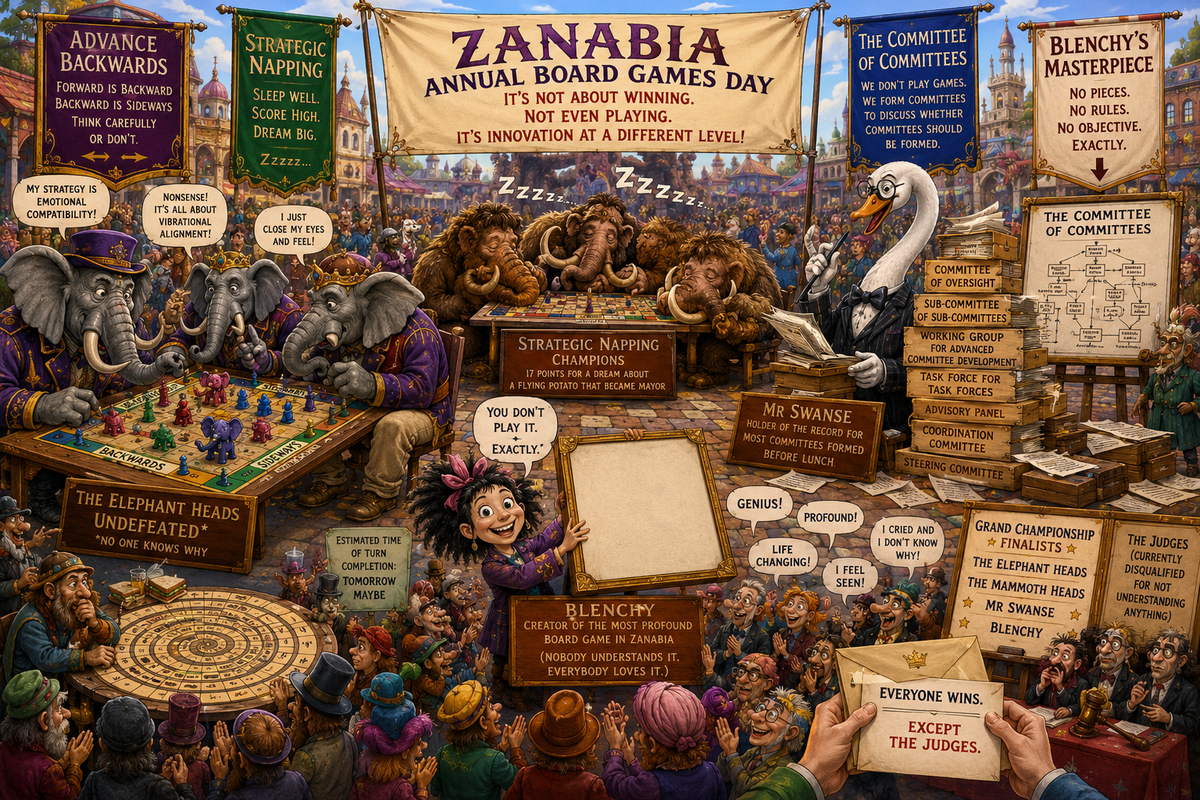
The annual Board Games Day arrived in ZANABIA with all the fanfare usually reserved for royal weddings, major sporting events, and particularly successful soup recipes. No one was entirely sure who organized it. No one was entirely sure what the games were. And by noon, no one was entirely sure what a board was. Yet spirits were high. The central square of ZANABIA was packed with tables, chairs, banners, scoreboards, snack carts, and several emergency confusion counselors standing by in case anyone accidentally understood what was happening.
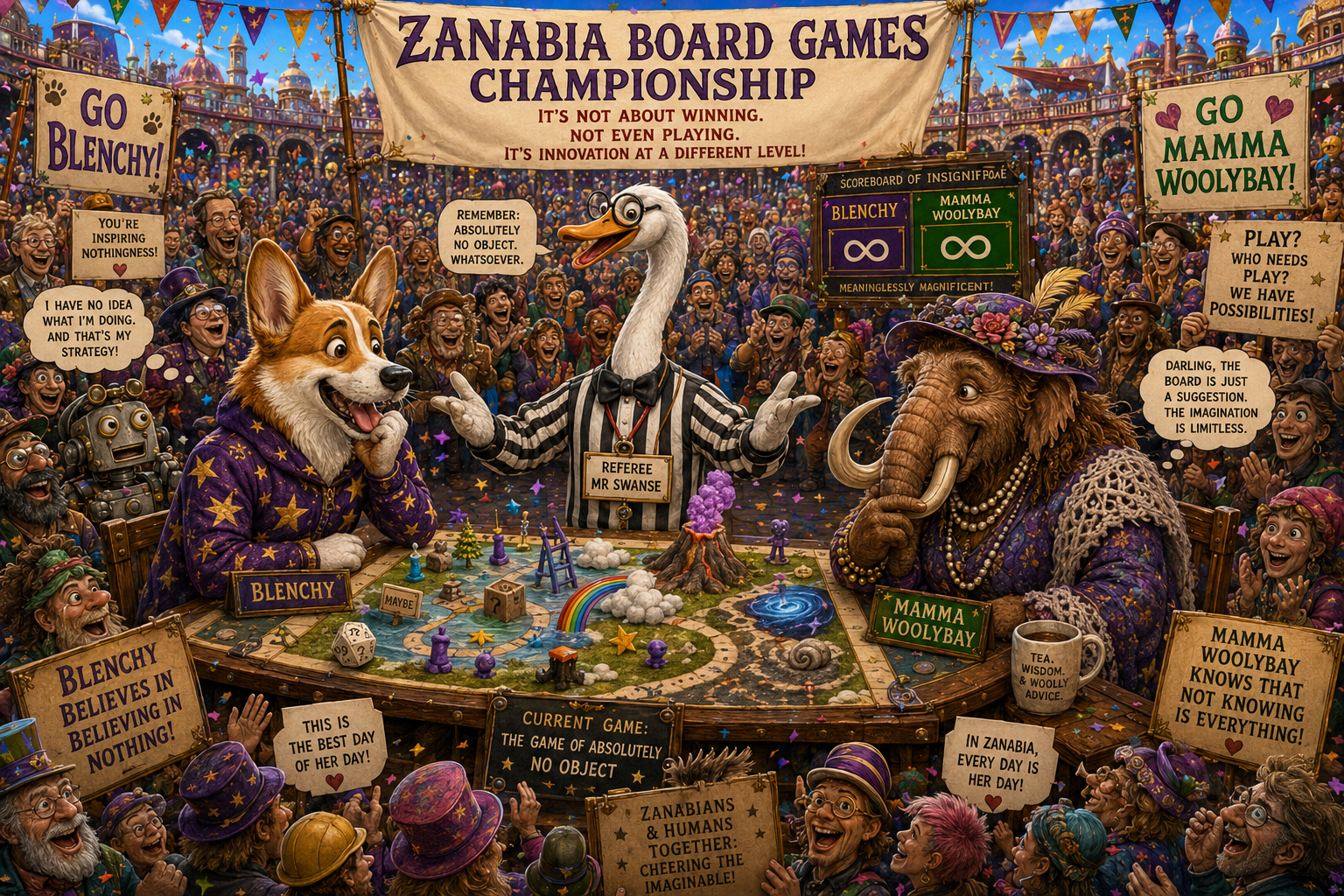
The most popular game was called Advance Backwards. The objective was simple. Move forward. The only problem was that every forward move counted as a backward move, unless the player was thinking about moving backward, in which case it became a sideways move. The Elephant Heads dominated the early rounds. Nobody knew why. Even the Elephant Heads did not know why. One of them proudly declared that his strategy involved closing his eyes and selecting pieces based on emotional compatibility. The crowd applauded. It sounded sophisticated. Nearby, the Mammoth Heads were competing in a game called Strategic Napping. Contestants sat around a large board and attempted to fall asleep before their opponents. Points were awarded for snoring rhythm, dream creativity, and overall posture. A Mammoth Head named Professor Woolrum reportedly earned seventeen points for dreaming about a flying potato that became mayor. The judges considered it visionary. Meanwhile, Mr Swanse had become the unexpected sensation of the festival. His chosen game was called The Committee of Committees. Players spent four hours forming committees whose sole purpose was to discuss whether additional committees were required. The game ended only when everyone forgot the original topic. Mr Swanse achieved a record score after establishing twelve committees, three subcommittees, and a Working Group for Advanced Committee Development. The trophy was immediately referred to another committee. Then there was Blenchy. Blenchy entered the championship division carrying a board game nobody had ever seen before.
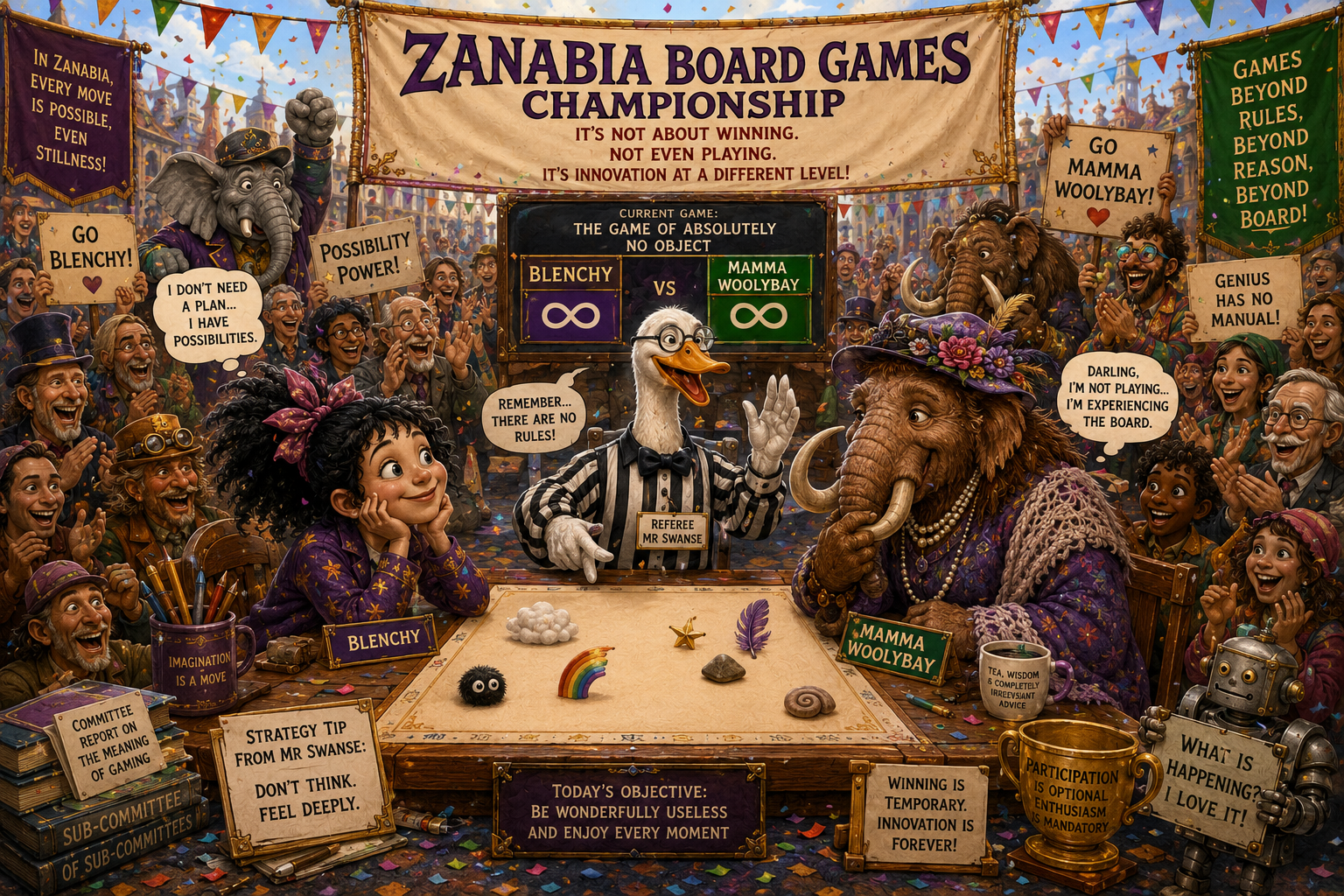
The board contained no squares. No pieces. No instructions. No visible objective. "How do you play?" asked an excited spectator. "You don't," said Blenchy. "What happens then?" "Exactly." The crowd erupted in applause. Several people claimed it was the deepest game they had ever experienced. Others said it represented the human condition. One gentleman simply burst into tears and bought a commemorative T shirt. The judges awarded Blenchy first place before realizing nobody had actually played anything. This caused a dispute. To resolve the dispute, another board game was invented. The dispute then won first place. Elsewhere, a team of enthusiastic Zanabians spent two hours attempting to learn a game called The Infinite Turn. The first player began his turn shortly after breakfast. He was still taking that turn at dinner. A small audience formed around him. People brought sandwiches. Children grew older. One nearby plant reportedly reached maturity. The player eventually declared he was "almost done thinking." At sunset, the grand championship was announced. The Elephant Heads. The Mammoth Heads. Mr Swanse. And Blenchy. The four finalists gathered before thousands of spectators. The judges opened a golden envelope. Inside was a note. The note read: "Everyone wins." The crowd cheered. Then another note fell out. It read: "Except the judges." The crowd cheered even louder. As evening settled across ZANABIA, the tables were folded away, the scoreboards were dismantled, and nobody could accurately explain who had won, who had lost, or whether any actual games had taken place. Yet every face carried a smile. Because in ZANABIA, victory was optional. Participation was optional. Understanding was definitely optional. But laughter was mandatory. And by that measure, it had been one of the most successful championships in history.