Bhaktiverse #3 Shiv Mandir on the Moon
Imagine a small Shiv Mandir standing beneath a sky full of stars, its spire illuminated by Earthlight.
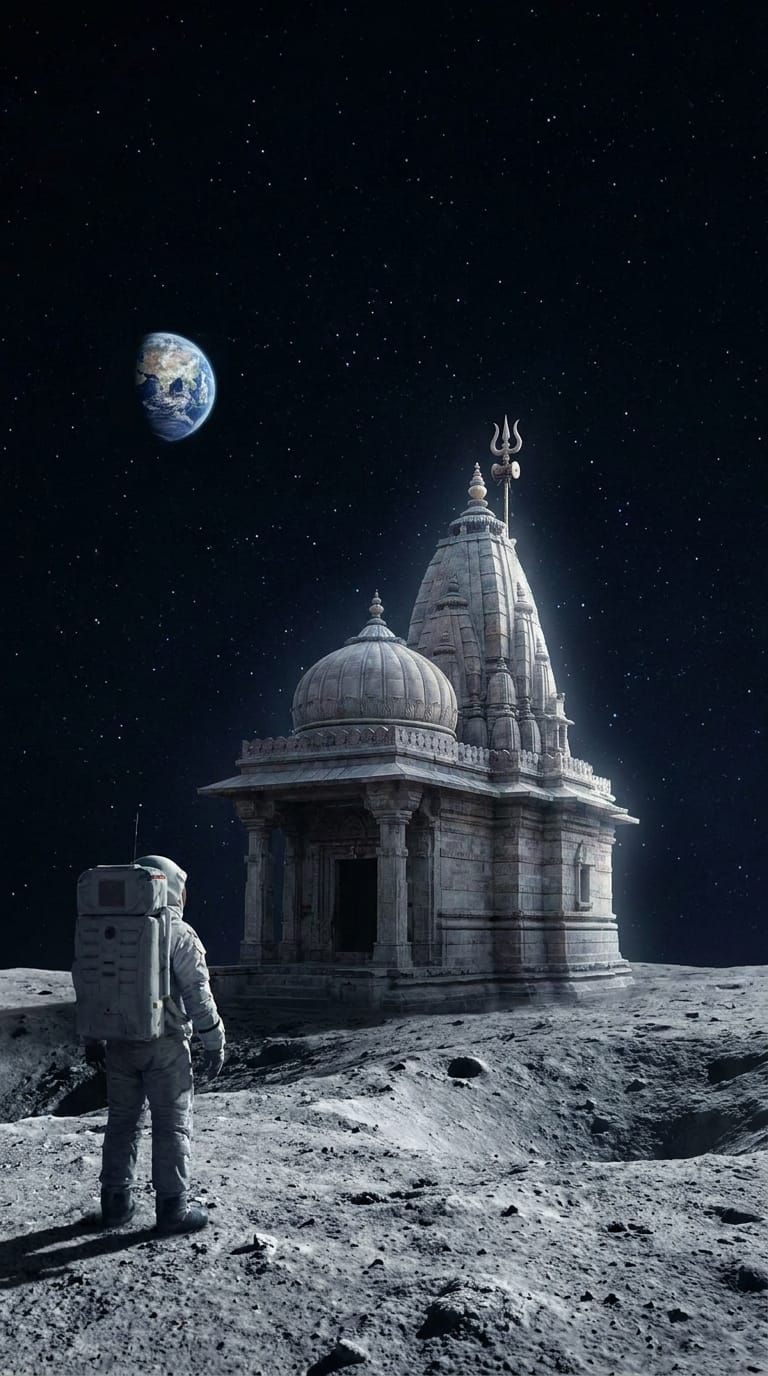
Where the Crescent Watches the Crescent There is something strangely beautiful about the idea. A Shiv Mandir standing silently upon the Moon. Not as a conquest. Not as a declaration. Not as a monument to human achievement. But as a reminder. A reminder that wherever humanity goes, it carries its questions with it. And among humanity's oldest questions is this one: What lies beyond? Beyond the horizon. Beyond the planet. Beyond the stars. Beyond life itself. For thousands of years, seekers sat beneath trees, in caves, on mountains, and beside rivers asking these questions. Today, astronauts ask them while floating above the Earth. Scientists ask them through telescopes. Children ask them while staring into the night sky. The questions remain the same. Only the scenery changes. In this imagined Bhaktiverse vision, an astronaut stands before a Shiv Mandir on the Moon. Behind him hangs the Earth, glowing blue in the endless darkness. Before him rises a temple dedicated to the Lord who is often called the Adiyogi, the First Yogi, the Great Ascetic, the Cosmic Dancer, and the Silent Witness. And then a delightful thought appears. The Moon has always belonged to Shiva. Not in ownership, but in symbolism. Upon Shiva's head rests the crescent moon, known as Chandra. It is one of the most recognizable features in his iconography. The crescent represents time, rhythm, cycles, and renewal. The waxing and waning moon reminds humanity that growth and decline are both natural parts of existence. So perhaps a Shiv Mandir on the Moon is not a strange idea at all. Perhaps it is simply the crescent returning to the One who wears it. The symbolism deepens further. The Moon is silent. There are no bustling markets. No traffic. No debates. No elections. No social media arguments. Only stillness. And Shiva has always been associated with stillness. Not the stillness of emptiness. The stillness of immense presence. The kind of silence that is not lacking anything. The kind of silence that contains everything. The sages often described meditation as reaching a state where the noise of the world gradually fades away. Standing on the lunar surface, one might feel something similar. Distances become difficult to comprehend. Human concerns appear smaller. Time itself seems to stretch into something vast and mysterious. Perhaps that is why this imaginary temple feels so natural. The Moon already resembles a giant meditation hall. Yet this vision is not about escaping Earth. Shiva has never represented running away from life. He represents seeing life clearly. The same deity who sits in meditation also dances as Nataraja. The same Lord who closes his eyes in contemplation also opens them to engage with creation. The lesson is not withdrawal from the world but mastery within it. An astronaut returning from such a temple would still have responsibilities. Bills would still exist. Families would still need care. Work would still need doing. The difference would be perspective. Earth would no longer seem merely like a collection of countries and conflicts. It would appear as a single glowing home suspended in cosmic darkness. A fragile blue sanctuary carrying billions of hopes, fears, dreams, and prayers. Perhaps that is one of the greatest spiritual lessons space exploration can offer. The farther we travel outward, the more precious home becomes. The farther we look into the universe, the more miraculous life appears. And the deeper we journey into the cosmos, the more we are drawn back toward questions of meaning. In many ways, science and spirituality are fellow travelers. One asks how. The other asks why. One studies the stars. The other studies the observer. One launches rockets. The other launches introspection. Both are journeys into mystery. Both require humility. Both begin with wonder. So in the spirit of Bhaktiverse, imagine a future where humanity walks across distant worlds carrying not only technology, machinery, and ambition, but also reverence, wisdom, and gratitude. Imagine explorers pausing not only to collect samples but also to contemplate existence. Imagine a small Shiv Mandir standing beneath a sky full of stars, its spire illuminated by Earthlight. No bells ringing. No crowds gathering. No ceremonies required. Only a silent invitation. To look outward. To look inward. And to remember that the universe is vast enough for both discovery and devotion. For after all, the Moon is already a crescent. And the crescent has always had a place upon Shiva's head. This Bhaktiverse artwork was created through a collaboration between human imagination, devotional inspiration, and AI assisted image creation. It is presented as a respectful and imaginative spiritual tribute rather than a depiction of physical reality.