A Rainy Day in ZANABIA
THE ZANABIAN HISTORICAL ARCHIVE Entry recorded by the Official Historian, filed under: Weather, Miscellaneous Joys It began, as all proper Zanabian rain does, with an announcement.
THE ZANABIAN HISTORICAL ARCHIVE Entry recorded by the Official Historian, filed under: Weather, Miscellaneous Joys
It began, as all proper Zanabian rain does, with an announcement. Not a forecast — ZANABIA has never trusted forecasts, on the grounds that they are simply weather gossiping about itself before it has made up its mind — but an announcement, delivered at six in the morning by three sparrows who took up positions on the weathervane above Mr Swanse's shop and sang, with great confidence, the tune everyone recognised as Rain By Lunchtime, Possibly Sooner. Mr Swanse came out in his slippers, his unmistakably Zanabian head tilted towards the sky and his small spectacles sitting at their usual doubtful angle.
"Right on schedule," he said, to nobody in particular, and went inside to move the biscuit tins away from the window, a precaution he took every rainy day and which had never once been necessary. He also, while he was at it, pinned a small sign to the door.
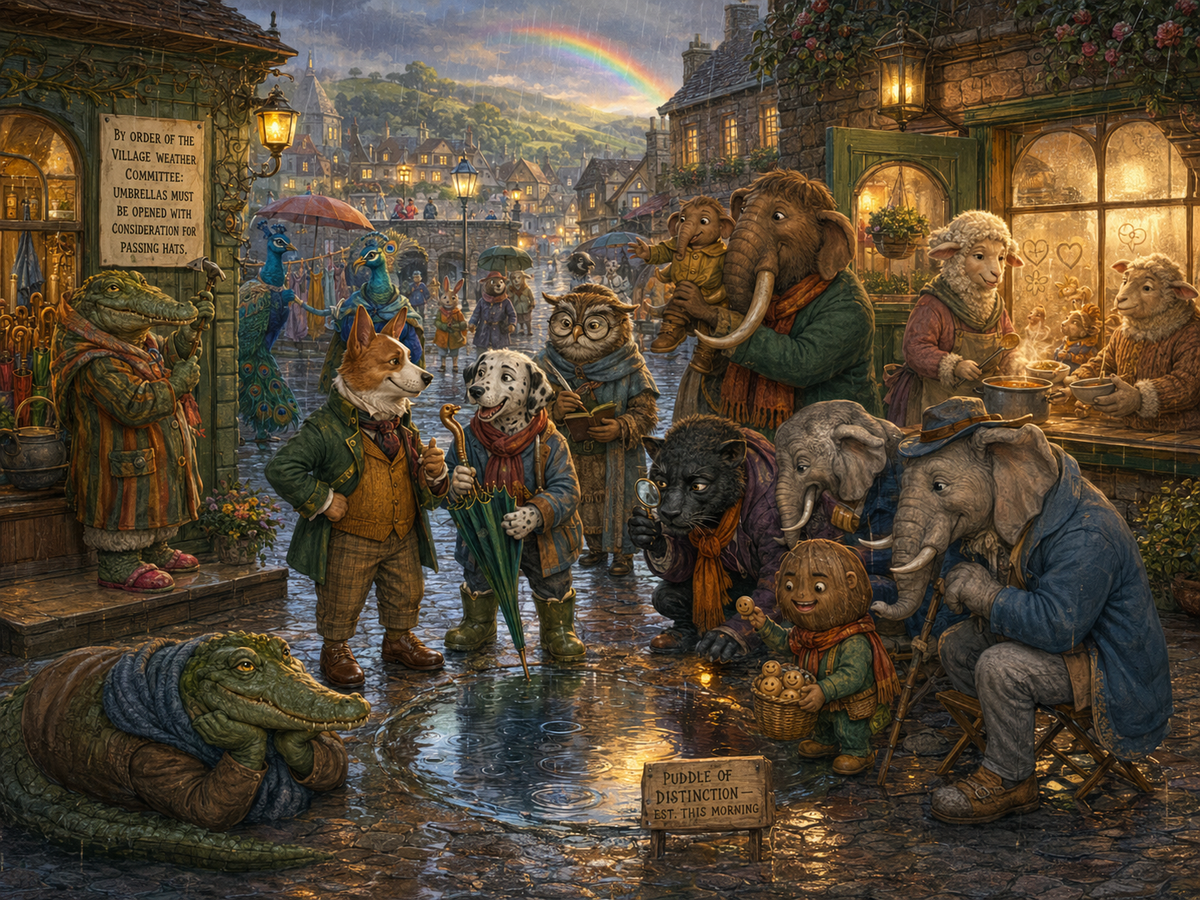
BY ORDER OF THE VILLAGE WEATHER COMMITTEE: UMBRELLAS MUST BE OPENED WITH CONSIDERATION FOR PASSING HATS.
There was no Village Weather Committee. There had never been a Village Weather Committee. Mr Swanse had invented it eleven seconds earlier, largely because the sign looked empty without a committee to blame it on, and by mid-morning three people had thanked him for the reminder. By nine o'clock the clouds had arranged themselves the way guests arrange themselves at a long table — unhurried, faintly competitive about the good seats — and at half past nine the first drop fell directly onto the head of a garden gnome belonging to the Coconut Head family. They considered this a great honour and left the gnome exactly where it stood for the rest of the day, in case moving it offended the rain's aim.
Rain in ZANABIA does not simply fall. It arrives. Doors open for it. Kettles go on. And on this particular Tuesday, as the first grey curtain came in off the hills, the whole village did what it always did when rain came calling.
It got cosier.
The Matter of the Unclaimed Umbrella On Chestnut Lane, Blenchy found an umbrella leaning against his railing. It was a good umbrella — deep green, slightly too large, with a handle carved into the shape of a duck that appeared to be having an argument with itself. Blenchy, a corgi-headed gentleman of considerable curiosity, currently in his second-best waistcoat because his best waistcoat was "resting," picked it up and turned it over twice, as though a second inspection might reveal an owner the first had missed.
"Stobby!" he called across the lane. "Is this yours?" Stobby arrived at a trot, wearing wellington boots two full sizes too large, which he maintained gave a man "something to grow into," despite having stopped growing some time ago. He examined the umbrella the way other people examine old maps. "No," he said. "But it looks like it belongs to somebody very reliable." "That's not an answer." "It's the only one I've got."
This was, by the Archive's count, the umbrella's fourteenth known appearance, and Blenchy — who had privately appointed himself Assistant Umbrella Investigator that morning, there being no Chief Umbrella Investigator, nor any vacancy, nor indeed any investigation until he started one — declared that it would be taken round the village for identification. Ms Sight, owl-headed and entirely certain of everything she said, examined it through her spectacles and pronounced it "an umbrella of good character, but not of local character," a distinction she did not explain and nobody asked her to.
Papa Woolybay said it reminded him of an umbrella his grandfather had owned, except his grandfather's had been blue, rather smaller, and — the longer he thought about it — quite possibly a hat. "So not much like it at all," said Stobby. "The spirit was similar," said Papa Woolybay, which settled the matter as far as he was concerned.
Nobody claimed it. Nobody ever did. The umbrella turned up once or twice a year, stood about looking useful, and vanished again, and the village had long since stopped asking whose it was and started simply admiring its manners. By noon it had been left, with quiet ceremony, outside Mama Woolybay's kitchen door, on the grounds — agreed by Blenchy, seconded by Stobby, disputed by nobody — that any umbrella of good breeding would want to be near soup. The Soup, and Other Matters of Great Importance.
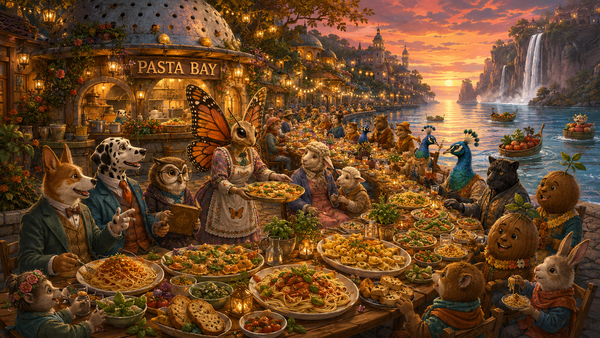
Mama Woolybay's kitchen on a rainy day was the warmest square footage in ZANABIA, and possibly beyond it. By eleven the windows had fogged from the inside, which the children treated as a canvas and covered at once with drawings of the rain itself — a friendly grey creature with many small polite legs, each wearing its own tiny boot.
The soup, carrot and something orange that might also have been carrot, simmered with the low, satisfied sound of something that already knew how good it was.
"Soup listens to the weather," Mama Woolybay said, to a kitchen that had heard this before and had no intention of stopping her. "Sunny days it stays thin and polite. Rainy days it puts on a bit of weight, to keep you company."
Blenchy, who had followed the umbrella in and stayed for entirely unrelated reasons, asked whether that was scientifically accurate.
"It's kitchen accurate," said Mama Woolybay, which is a higher standard, and ladled him a bowl before he could disagree. By early afternoon six neighbours had wandered in, which is how rainy-day visiting worked in ZANABIA: someone arrived, and another bowl appeared. Each declared, tasting the soup, that it was the warmest bowl they'd ever had, and each was quietly certain their own arrival was what had done it.
A small dispute broke out — the Coconut Head youngest against one of the Elephant Head cousins — over whether the puddle forming outside was worth going to see in this weather. It was resolved, as most things in that kitchen were, by Mama Woolybay adding two more bowls to the table and suggesting they discuss it sitting down. They discussed it sitting down for forty minutes, and then went to see the puddle anyway.
The Puddle on Marrow Street By half past twelve, the puddle outside the bakery on Marrow Street had become, by unanimous informal agreement, a tourist attraction. It was not, on the face of it, a remarkable puddle — roughly the size and shape of a worried potato — but the eldest Panther Head crouched beside it with the composure of someone appraising fine art. "Very good reflection," she said. "You can see the clouds moving in it. Most puddles don't bother."
An Elephant Head, arriving with two folding stools already under one arm out of general preparedness, offered a third to a Peacock Head who had not asked for one but accepted graciously anyway, fanning her feathers slightly against the drizzle in a way that suggested the puddle was, in her opinion, rather flattered by the attention. A Mammoth Head, being considerably taller than everybody else present, did not need a stool and instead gave a running commentary on the puddle's finer qualities from above, occasionally lifting a small child onto his shoulders so they could see for themselves.
"Best puddle this year," the child announced, with the total authority of someone who had seen at least two others. "High praise," said the Panther Head, without looking up.
The youngest Coconut Head, ever entrepreneurial, attempted to charge admission of one smile per viewing. He collected several dozen and, by his own account, several dozen more than expected, and declared it his most successful afternoon since the Great Pinecone Sale of the previous spring, an event for which the Archive possesses no records, only several pinecones.
A hand-lettered sign went up: PUDDLE OF DISTINCTION — EST. THIS MORNING. Ms Sight arrived last, studied the puddle for some time, and announced that according to a regulation she did not name and possibly did not possess, any puddle attracting more than twelve admirers automatically qualified for "Distinction" status, and that this one had qualified an hour ago and simply hadn't been told. It seemed, on the whole, only fair.
An Allofator arrived some time later and lay down beside the puddle entirely, chin on crossed arms, watching the rings spread outward with an expression of such complete contentment that several villagers stopped what they were doing simply to watch him watching it. He said nothing the whole time. He did not need to. The Laundry Incident The rain very nearly arrived twenty minutes earlier than it did, and the reason for the delay is a matter of settled Zanabian record.
Mrs Peacock Head had left an extraordinary quantity of laundry on the line behind her house — scarves, shawls, and one enormous tablecloth patterned after a sunset — and was three streets away, deep in a conversation about button thread she had every intention of finishing.
When the sparrows sang their announcement, the rain hovered over the hills, sent down one testing drop, and waited. It sent another. It waited again, in the particular manner of a guest tapping a foot politely at the door. Mrs Peacock Head was seen sprinting home with the specific, magnificent urgency of someone who has just remembered laundry, and only then did the rain begin in earnest, satisfied that honour had been served.
"It's only manners," said Mr Swanse, watching from his window, and — feeling the moment required it — pinned up a second sign.
WEATHER COMMITTEE NOTICE: RAIN WILL CONTINUE TO WAIT FOR LAUNDRY. THIS IS NOT A GUARANTEE. IT IS A COURTESY.
Nobody had asked for clarification. He provided it anyway, on principle. The Rainbow Committee By four the rain had softened to the thoughtful sort of drizzle that means an ending is coming, and a small delegation gathered in the square to discuss the matter of the rainbow.
It is Zanabian custom, and has been for as long as anyone can recall, that rainbows do not appear before receiving unanimous neighbourhood approval. Ms Sight presided, spectacles lowered for the occasion.
"All in favour," she said, "of a rainbow this evening, over the eastern hills, with a strong red end?"
A show of hands. Several tails. One trunk, raised with enthusiasm slightly ahead of the question being finished. "Carried," said Ms Sight, and made a note in a small book that the Historian has never been permitted to examine and suspects contains nothing at all.
Blenchy, still technically on umbrella business, asked whether the vote could be reconsidered in favour of an orange end instead.
Stobby seconded this purely out of loyalty, without an opinion of his own, and the motion was defeated eleven votes to two, with the two voters shaking hands afterward as though they'd won something. At seventeen minutes past five, precisely as promised, the rainbow arrived over the eastern hills with a red end so strong that three people applauded and Mr Swanse rang the little brass bell over his shop door, ordinarily reserved for customers.
Evening The rain left behind a smell the Historian had never managed to describe properly — wet stone, warm bread, and the inside of a very old, very well-loved book. Fires were lit less from necessity than from the sense that the day had earned one. Somewhere near the square an accordion appeared, as accordions on rainy evenings tend to, and nobody could ever say who had brought it, only that it was suddenly playing.
Stobby danced badly and with tremendous enthusiasm. Blenchy, who considered himself the more dignified of the two, danced almost as badly four seconds later, once he had decided it was allowed. The umbrella dried quietly by Mama Woolybay's stove. The Puddle of Distinction held its reflection of the first stars. Somewhere a real dog — the four-legged kind, not to be confused with the gentlemen — chased a puddle with great bravery until the puddle, without warning, chased back, at which point the dog remembered urgent business elsewhere.
A child asked her grandmother why the rain was so nice. "Because everybody decided it should be, a long time ago," her grandmother said, "and nobody's seen a reason to change their mind since."
Nothing dramatic had happened in ZANABIA that day. Nothing at all, really — except that the rain had come to visit, and everyone had remembered to answer the door.
Filed in the Zanabian Archive under: Weather, Community, Soup See also: Umbrellas, Ownership Unknown